
B2B Consulting Income: How to Start While Employed
Start B2B consulting while employed: pick one skill, offer a fixed-scope project, set a clear price, and sell to warm contacts.
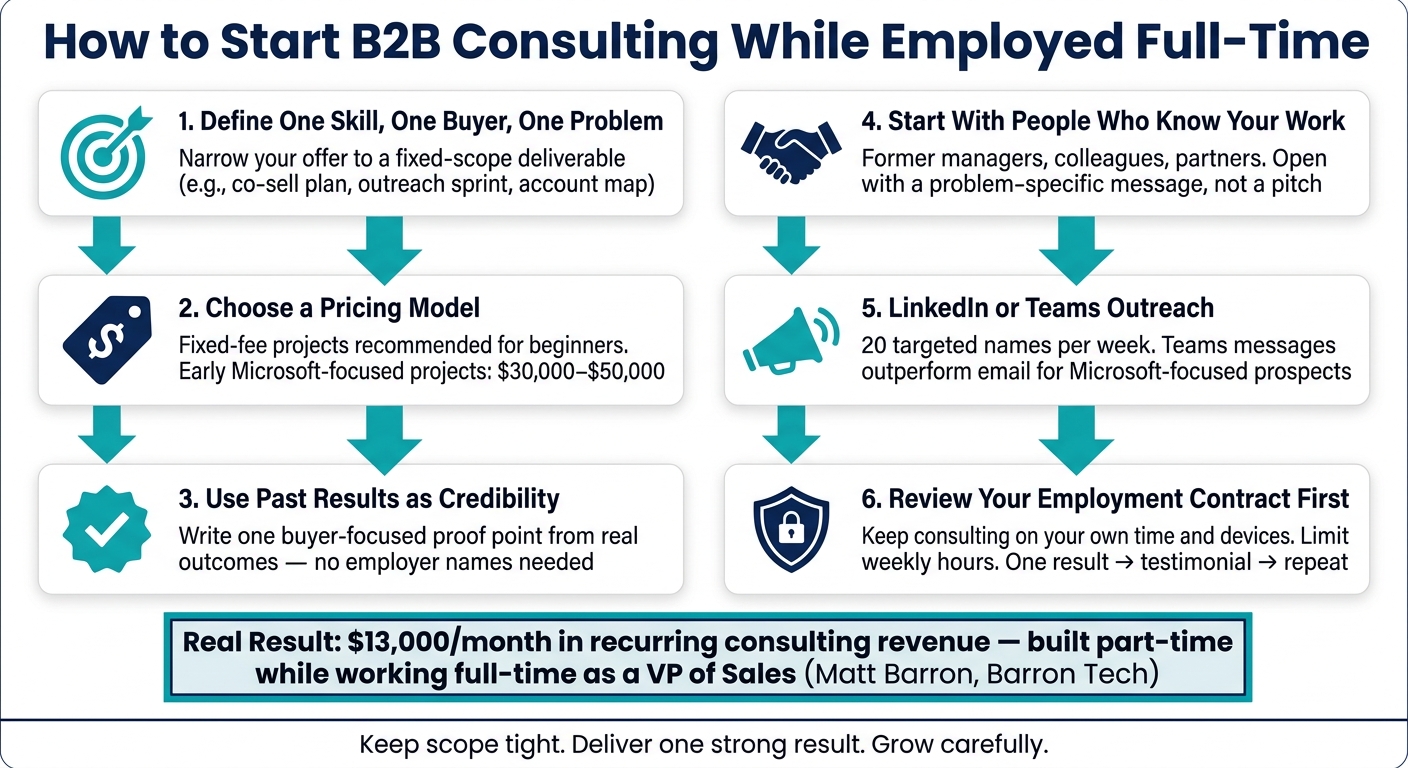
Yes - you can start B2B consulting while keeping your full-time job. The short version is simple: pick one skill, turn it into one fixed offer, set a clear price, and start with people who already know your work.
Here’s the core playbook:
- Choose one buyer and one problem
- Package one clear deliverable
- Use past results as proof
- Start with fixed-fee project work
- Reach out to warm contacts first
- Track outreach and deadlines with simple tools
- Check your job’s rules before taking client work
- Keep your scope and weekly hours tight
A strong example from the piece: one Microsoft-focused consultant grew to $13,000 per month while still employed full-time by selling a narrow GTM service. The article also notes that early Microsoft-focused projects can fall in the $30,000 to $50,000 range, which shows why a narrow offer can be worth more than broad “help with anything” consulting.
If I had to sum it up in one line, it would be this: don’t build a big side business at first - sell one small project you can finish well without putting your job at risk.
Quick comparison
| Area | Best starting move | Why it works |
|---|---|---|
| Offer | One fixed-scope project | Easier for buyers to understand and approve |
| Pricing | Fixed fee | Clear start, end, and payment |
| Client source | Warm contacts | Higher reply rates and shorter path to a call |
| Outbound | LinkedIn or Teams | Easier to fit around a full-time job |
| Delivery | One result in 30–90 days | Lower chance of scope creep |
| Risk control | Review job contract first | Helps avoid conflict with employer rules |
What I like about this approach is that it stays simple. You keep your paycheck, test demand with low risk, and build from work you already know how to do.
Pick one consulting offer a company will pay for
Turn your skill into a fixed-scope offer that a buyer can grasp fast. Pick one buyer, one problem, and one deliverable. Broad consulting is hard to buy. Clear projects are much easier.
Turn existing skills into fixed-scope offers
Start with work you already know how to do, then carve off one small part and package it as a standalone project. That’s the sweet spot.
| Skill You Already Have | Fixed-Scope Offer | Deliverable | Timeline |
|---|---|---|---|
| Microsoft partner GTM | Partner GTM planning | Co-sell plan + seller target list | 30–90 days |
| Pipeline outreach | 30-day outreach sprint | Sequenced outreach + booked meetings | 30 days |
| Account management | Account coverage map | Heatmap of accounts by priority | 30–90 days |
| Campaign launch | Campaign build and launch | Live campaign + performance report | 30–90 days |
| Partner program management | Pursuit support | Deal strategy + seller activation plan | 30–90 days |
A defined scope protects your time. It also makes the offer easier for a buyer to approve. If you’re doing this part-time, that matters a lot. A tight scope is simpler to sell, simpler to deliver, and less likely to spiral.
Write a one-sentence offer statement
Before you talk to anyone, write what you do in one plain sentence. Keep it simple: who it serves, the problem, the deliverable, and the result you expect.
Here’s a practical example: “I help Microsoft partners book co-sell meetings with field sellers by building a targeted outreach plan and account coverage map, delivered in 30 days.” That tells a buyer what they’re getting and what should happen next.
If the sentence still feels fuzzy, tighten it. Narrow the buyer, narrow the problem, or narrow the deliverable until it feels concrete.
Once the offer is clear, position it and set a starting price.
Position your experience and set a starting price
Use proof from real work to build credibility
Now you have one clear offer. The next step is simple: turn your past work into proof, then tie that proof to a starting price.
Use work you’ve already done to show you can deliver the offer you defined. You don’t need to name your employer or share private details. In fact, you shouldn’t. Just talk about the outcome in a way that feels concrete. For example, you might say you supported co-sell motions at a Microsoft-focused partner firm or built account heatmaps for seller targeting. That gives the buyer enough detail to trust you without crossing any lines. The buyer cares about the result, not the logo.
Put the spotlight on repeated outcomes and process wins. Maybe you helped a team move pipeline faster, built a seller target list, or improved a co-sell workflow. Those are the kinds of proof points that matter. Take those results and shape them into one buyer-focused proof point that says, in plain English, what changed because of your work.
Once that proof is clear, use it to back up your starting price.
Start with hourly, project, or retainer pricing
For a first engagement, pick a pricing model that a buyer can approve fast and that you can handle part-time.
There are three common options:
| Pricing Model | Best Fit | Main tradeoff | Predictability |
|---|---|---|---|
| Hourly | Discovery calls, ad-hoc troubleshooting, early conversations | Caps your income; can drag out delivery | Low |
| Fixed Project | Defined deliverables with a clear start and end date | Requires tight scope control to avoid creep | Medium |
| Retainer | Ongoing advisory or fractional support | Requires consistent availability each month | High |
For most people just getting started, a fixed-price project makes the most sense. It gives the buyer one number to approve and gives you a clear finish line. Fixed-price pilots are recommended for early-stage consulting, especially when the scope is narrow enough to ship in about eight weeks [3].
Initial Microsoft-focused consulting or co-sell opportunities often range from $30,000 to $50,000 [2].
Find first clients through warm outreach and a simple workflow
Your first paying client will usually come from people who already know what you can do. So start there.
Start with former colleagues, trusted contacts, and referrals
Make a short list of people who’ve seen your work up close: former managers, co-workers, partners, or trusted contacts you’ve worked with before. Then send a message tied to a clear problem, not a broad “I’m available” note.
For example: “If seller follow-up or pipeline consistency is a priority, are you open to a 20-minute call next week?”
That works better because you’re not pitching a company. You’re opening a short conversation around a real pain point.
If your warm list slows down, add one outbound channel you can keep up with.
Add one outbound channel you can manage
After you’ve worked through your warm list, pick one outbound channel and stick with it. LinkedIn direct outreach is a solid option when you’re still working full-time. It’s simple, easy to fit into a busy week, and doesn’t need a huge system behind it.
For Microsoft-focused prospects, Teams messages often outperform email for speed and engagement [2]. And you don’t need a giant volume play here. A focused batch of 20 targeted names per week is manageable and can generate real results [2].
Here’s how the main outreach methods stack up when you’re still employed full-time:
| Outreach Method | Effort | Speed | Response Quality |
|---|---|---|---|
| Warm Referrals | Low | Fast | Very High |
| LinkedIn Direct | Medium | Medium | Medium/High |
| Targeted Email | High | Slow | Variable |
Once conversations start, keep your process simple. The goal isn’t to build a fancy system. It’s to make sure follow-up doesn’t slip through the cracks.
Use simple tools to manage outreach and delivery
You don’t need a complex tech stack. Use one tool to track outreach, one place to store notes, and one calendar for delivery deadlines. That’s enough to stay organized without adding extra work or pulling you away from your day job.
Use the lightest system that helps you track:
- who you contacted
- what was promised
- what comes next
Protect your job, deliver well, and grow carefully
Check conflict, confidentiality, and moonlighting rules first
Once outreach starts, protect the work as carefully as you sell it. Before you contact a single prospect, read your employment agreement closely. Focus on clauses about outside work, intellectual property ownership, confidentiality, and competitive activity.
Keep consulting work on your own time, on your own devices, and away from employer systems. If you’re thinking about forming an LLC, get legal or tax advice first.
Run a part-time delivery system you can sustain
After those guardrails are clear, run the work with a part-time setup you can keep up with.
Start with a small first engagement. One workflow, one measurable outcome, and a fixed timeframe are enough to produce a solid result without eating up your week.
Matt Barron, Founder of Barron Tech, built his side consulting business to $13,000 per month in recurring revenue while working full-time as a VP of Sales [1]. That’s a good reminder that part-time doesn’t have to mean sloppy or random.
Use calendar blocking and set a weekly capacity limit you can maintain. Aim for one strong result you can turn into a testimonial, referral, or repeatable process.
Keep scope tight, delivery simple, and capacity limited.
FAQs
How do I know if my offer is narrow enough?
Your offer is narrow enough when it speaks to a specific ICP and solves one concrete, high-value problem instead of trying to do general consulting.
So, skip broad technology consulting. Aim at a clear outcome, like industry-specific Microsoft 365 implementations or a specialized pipeline-building motion. A simple gut check: if you’re willing to turn away prospects who don’t fit, your offer is probably focused enough.
What should I charge for my first consulting project?
Aim for the high end of the market instead of throwing out a guess. Set your price around a clear offer tied to your own work history and the outcomes you can drive, like Microsoft partner GTM strategy or pipeline building.
That way, your pricing lines up with the value of your specialized corporate skills. It also gives you a cleaner system for selling the offer while you keep your full-time job.
How can I avoid conflicts with my full-time employer?
Build your consulting offer around what you already know. Then turn that know-how into a separate service you can deliver within the time you actually have.
That means keeping the work clearly tied to your own skills, methods, and experience. Not your employer’s tools. Not internal data. Not private information. And not anything that blurs the line between your day job and your side work.
Set firm boundaries from the start. Decide when you’re available, what you will deliver, and how much work fits into your schedule without putting pressure on your main job. That keeps both sides steady and lowers risk.
A simple rule helps here: if the service depends on employer resources, confidential material, or access you only have because of your role, leave it out. Build the offer on what’s yours, keep the scope tight, and make sure the work stays easy to manage.