
Best Consulting Pitches for Busy Corporate Buyers
Short, outcome-focused pitching templates for busy corporate buyers: one problem, one proof point, one simple next step.
Busy corporate buyers respond to short pitches with one problem, one proof point, and one simple next step. In the data shared here, email reply rates drop from 3.6% for messages under 50 words to 1.7% once they pass 150 words. That’s the big takeaway: if I want a reply, I need to cut the setup and get to the point fast.
Here’s the article in plain English:
- I should use a short email when I have a clear trigger and need direct attention.
- I should use a LinkedIn note when I have light context and just want a reply or connection.
- I should use a referral forward when someone trusted can open the door for me.
- I should use a voice note or voicemail when email stalls and the buyer already knows my name.
- I should use a first-call opener to set the agenda fast once a meeting is booked.
The main pattern stays the same across every format:
- Trigger: why I’m reaching out now
- Outcome: what business result I can point to
- Next step: one small ask
Warm intros also stand out. The article notes that they can lead to meetings at 5x to 10x the rate of cold outreach, with response rates around 40% to 50%, versus about 2% for cold email. And for voice, the window is short: 20 to 30 seconds is the target.
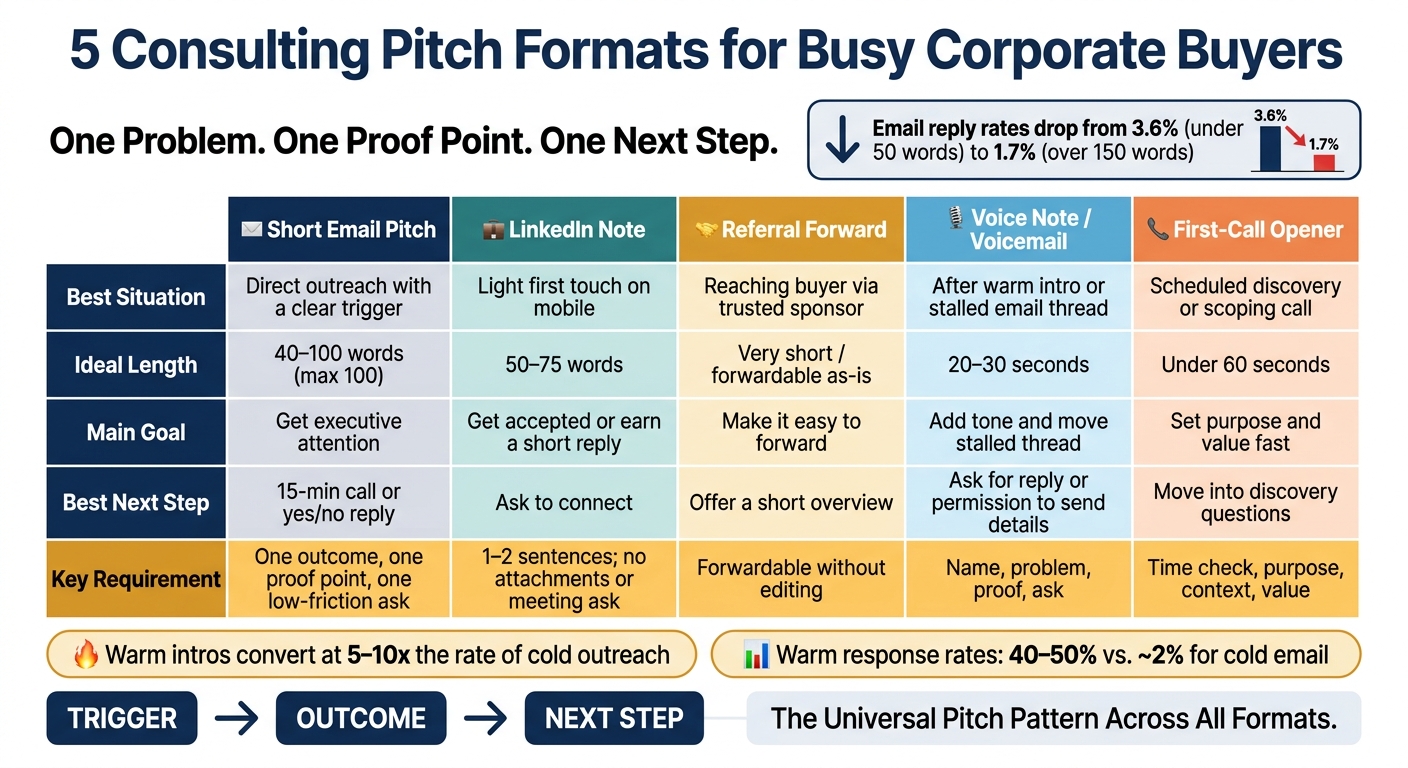
How To Pitch Consulting Services (Like A Successful Consultant)
Quick Comparison
| Format | Best time to use it | Ideal length | Main goal | Best next step |
|---|---|---|---|---|
| Short email | Direct outreach with a clear trigger | 40–100 words | Get executive attention | Ask for a short call or yes/no reply |
| LinkedIn note | Light first touch | 50–75 words | Get accepted or get a short reply | Ask to connect |
| Referral forward | Warm intro through a shared contact | Very short | Make it easy to forward | Offer a short overview |
| Voice note / voicemail | After a warm intro or stalled thread | 20–30 seconds | Add tone and move the thread | Ask for a reply or permission to send details |
| First-call opener | Start of a booked meeting | Under 60 seconds | Set purpose and value fast | Move into discovery |
If I had to sum up the full article in one line, it would be this: match the format to the buyer’s time, attention, and level of trust.
1. Short Email Pitch for Executive Attention
A short email pitch works because executives don’t read email the way most people do. They scan for relevance, fast. One breakdown of 47.3 million emails found that reply rates drop as messages get longer: 3.6% under 50 words, 3.1% at 50–100 words, 2.4% at 100–150 words, and 1.7% over 150 words.[1] For C-suite buyers, the sweet spot is 40–75 words, with a recommended ceiling of 100 words.[3]
When to Use a Short Email Pitch
Use this format when timing matters and you have a clear reason to reach out.
It works best in four cases: cold outreach tied to a credible trigger, like a new role, a cloud migration, or a Microsoft program announcement; a warm follow-up sent within three business days of an event; Microsoft co-sell outreach to field sellers or partner development managers; and re-engaging a buyer who agreed the problem was real, then went quiet.
Email works well here because buyers can skim it, think about it, and forward it if needed. That’s the point. If the buyer needs a little room before responding, email gives them that room.
What to Include in 4 Lines
This format is about speed and clarity, not a long setup. The structure stays the same every time:
- Reason for outreach - explain why you’re reaching out now, in one short clause tied to something real, like a public initiative or a Microsoft co-sell motion.
- Buyer problem in their language - stick to plain business terms such as pipeline, revenue, risk, or adoption. Skip consulting jargon.
- One proof point - give one hard number with a time frame, such as helped a U.S.-based ISV grow qualified co-sell pipeline from $2.3M to $3.1M per quarter without adding headcount.
- One low-pressure ask - make it easy to say yes, like a 15-minute call, a one-page summary, or a yes/no question.
If co-sell or marketplace context matters, work it into either the reason for outreach or the proof point. Lead with outcomes, not acronyms. For example:
“We helped a partner lift marketplace-influenced revenue 27% in two quarters through co-sell plays. Open to a 20-minute comparison call?”
Email Pitch Formats by Situation
| Format | Ideal Buyer | Word Count | Proof Style | Best Use Case |
|---|---|---|---|---|
| Problem-led | Executive with a known pain point | 70–90 words | Metric-based (e.g., pipeline $ growth, % change) | Cold outreach with a credible trigger |
| Event-triggered | Leader you met at a conference or webinar | 75–100 words | Outcome tied to a shared moment | Follow-up within 3 business days of an event |
| Referral-anchored | Warm contact introduced by a mutual connection | 50–75 words | Relationship-based (for example, helped [Name] with a similar issue) | Leveraging existing trust for fast access |
| Co-sell specific | Microsoft partner GTM lead or field seller | 75–100 words | Microsoft motion result (co-sell pipeline, marketplace revenue) | Aligning with Microsoft co-sell priorities and seller incentives |
Subject lines matter more than most people think. Keep them short and tied to an outcome, ideally under eight words. Lines like Quick idea on partner-led FY26 revenue goals or Accelerating co-sell pipeline with your Microsoft team tend to beat vague openers like Strategic advisory services because they point to a current priority instead of sounding like a generic pitch.[2]
If email feels too cold, switch to a LinkedIn note or a forwardable referral.
2. LinkedIn Note and Referral Forward for Warm Access
Warm-access pitches work for a simple reason: trust cuts friction. In both formats, trust and context matter more than length. Use LinkedIn when the buyer knows your name, but not your value yet.
LinkedIn Note for a Light First Touch
A LinkedIn note works best when you have light but real context in common. Maybe the buyer wrote a post, you both attended the same event, you share a mutual connection, they just changed roles, or a partner intro is possible but hasn’t happened yet. The note has ONE job: get the connection request accepted or earn a short reply. It is not the place for a pitch.
Keep it between 50 and 75 words so it shows cleanly on mobile without getting cut off. Start with something specific tied to what the buyer actually said or did. Then mention one business problem in plain English. End with a low-pressure prompt like “Open to connecting?” or “Worth comparing notes?” Skip the meeting ask.
A simple way to think about it:
- One line of personal context
- One line on who you help
- One easy reason to connect
Senior buyers skim fast, often on their phones, and they tune out anything that sounds like promotion. The notes that get replies feel personal, not pasted from a template.
If a trusted contact can introduce you straight away, use a forwardable email instead.
A Short Referral Email Your Contact Can Forward Right Away
A forwardable referral email plays a different role. In this case, an internal contact is lending you their credibility, so the message needs to be easy to pass along with almost no editing. Write it so the referrer can forward it as-is, without having to rewrite it or add context for you.
The structure is simple: who you help, the problem you solve, one concrete result, and one low-risk next step. For example:
I work with corporate teams that need help improving Microsoft partner execution. We help reduce pipeline friction and clarify the co-sell motion. In a recent engagement, we improved follow-up consistency within weeks. If useful, I’m happy to share a short overview.
Warm introductions convert to meetings at 5–10x the rate of cold outreach, with response rates averaging 40% to 50% compared to roughly 2% for cold emails.[4][5] That’s why the referral email matters so much. It gives the intro momentum.
If you have direct access but can’t get attention by email, a voice note or voicemail is the next move.
LinkedIn Note vs. Forwardable Referral: Side-by-Side Comparison
| Feature | LinkedIn Note | Forwardable Referral Email |
|---|---|---|
| Buyer Familiarity | Low to medium; based on digital footprint or shared event | High; based on an existing professional relationship |
| Who controls the message | High; you write and send it directly | Moderate; depends on the referrer forwarding your draft |
| Typical Response Pattern | Short reply, profile view, or connection acceptance | Direct introduction, forwarded thread, or more serious consideration |
| Best Use Case | After a shared post, event, role change, or partner introduction | Accessing senior buyers through an internal champion |
The choice comes down to one thing: how much trust is already there? If the context is light, start with a LinkedIn note. If a trusted contact can open the door, hand them a forwardable email and make it easy to send.
If a live conversation is on the table, the next step is the voice note or first-call opener.
3. Voice Note and First-Call Opener for Warm or Already-Engaged Contact
When email and LinkedIn start dragging, voice can move things along. It works best when the buyer already has some context, but text alone isn’t getting a response. Voice adds tone, speed, and a bit more human presence when a thread stalls. That matters, because executive attention tends to fall off in the first 8–10 seconds [9][11].
How to Structure a Voice Note or Voicemail in 20 to 30 Seconds
Keep voice notes short: 20–30 seconds. Once you go past 30 seconds, callback rates tend to drop hard [6][7].
A simple five-part structure keeps the message focused:
- Name and role (3–5 seconds): Hi Sarah, this is James Carter - I help SaaS customer success teams reduce churn.
- Reason for reaching out (3–5 seconds): Link it to a trigger, like a past email, a referral, or a visible initiative.
- One measurable problem (5–7 seconds): Use a number the buyer cares about, in their own language - for example, churn ticked up to around 9% in Q2.
- One proof point (5–7 seconds): We helped a similar team bring churn back under 5% within two quarters.
- One simple ask (3–5 seconds): Make it easy - reply with summary and I’ll send a one-page overview.
Voice notes tend to work best after an initial email or when you have a warm referral [8][10][12]. If someone inside the company - say, an operations leader or finance partner - has already mentioned your name, voice gives you a clean way to use that context. It can carry weight in a way a forwarded email often can’t.
If the buyer is already booked for a conversation, skip the extra message and use a call opener instead.
How to Open a First Call With a Clear Agenda
A live call opener has one job: show the buyer, fast, that this conversation deserves their time - and the spot on their calendar. You can do that in under 60 seconds with four moves:
- Time check: We have 30 minutes scheduled - does that still work for you?
- Purpose: My goal today is to understand how your team is managing implementation backlog and see whether there’s a fit.
- Context recap: From your ops director’s note, I gathered that projects are slipping by 2–3 weeks on average, which is creating pressure on your Q4 revenue targets.
- Value statement: If there’s a fit, you’ll leave with clear blockers and next steps.
Done well, this kind of opener checks the time, shows that you did your homework, and gives the buyer a clear sense of where the call is going. It feels prepared, not stiff.
Voice Note vs. First-Call Opener: Side-by-Side Comparison
Use the table below to decide when async voice makes more sense than a live opener.
| Feature | Voice Note / Voicemail | First-Call Opener |
|---|---|---|
| Channel | Asynchronous audio: voicemail, LinkedIn voice note, or Teams voice note | Live conversation (phone, Teams, Zoom) |
| Ideal Timing | After an email or warm referral | Scheduled discovery or inbound meeting |
| Ideal Length | 20–30 seconds | 60 seconds or less for the opening segment |
| Strengths | Adds urgency and personal tone; breaks through inbox noise | Sets a clear agenda; confirms value before discovery begins |
| Best Use Case | Stalled email thread, referral with strong context, time-sensitive initiative | Co-sell introductions, new buyer discovery, inbound meeting follow-through |
| Follow-Up Action | Short email recap referencing the voice note | Transition directly into discovery questions |
Conclusion: Match the Pitch Format to the Buyer’s Time and Context
Busy buyers reward clarity, not effort. Lead with one problem, one proof point, and one small next step they can answer in 30 to 60 seconds.
Steady results come from a process you can use again and again. Start with one core message: define your outcome, proof, and ask once, then tailor that same message for email, LinkedIn, referrals, voice notes, and calls. Barron Tech’s Co-Sell Buddy and Economic Resilience OS help support repeatable Microsoft go-to-market messaging. Use the quick reference below to match the format to the buyer’s moment.
5 Formats at a Glance
| Format | Best Situation | Key Requirement |
|---|---|---|
| Short email pitch | Direct outreach to an executive with a clear, relevant trigger | One outcome, one proof point, one low-friction ask. |
| LinkedIn note | Light first touch with a senior contact scrolling on mobile | 1–2 sentences; no attachments or meeting ask. |
| Referral forward | Reaching a busy decision-maker through a trusted sponsor | Forwardable without editing. |
| Voice note / voicemail | Personal follow-up after a warm intro or stalled email thread | 20–30 seconds; name, problem, proof, ask. |
| First-call opener | Scheduled discovery or scoping call with an already-engaged buyer | 60-second opener; time check, purpose, context, value. |
Use the format that fits the buyer’s moment, keep the core story the same, and end with a small next step.
FAQs
How do I choose the right pitch format?
Match the format to how buyers scan and how easy your offer is to grasp.
Start with a one-page, outcome-focused pitch. Make it clear:
- who it’s for
- what problem it solves
- why it matters now
Then pick the channel that fits the moment. A short email works when you need quick relevance. LinkedIn or DM works better for outreach that feels personal. And if time is tight, send a draft they can forward or a voice outline they can skim fast.
If your scope feels too broad, tighten it up. Focus on one buyer, one problem, and one deliverable.
What should I do if I have no warm intro?
Build a tight target list around your specific offer. Then use LinkedIn Sales Navigator to zero in on your ideal customer profile instead of blasting broad outreach.
From there, spend a little time on each prospect. Look at their recent work, interviews, posts, or podcast appearances. Find out what they care about right now. Then engage with their content in a way that shows you paid attention.
When you reach out, keep it short. Send a personalized message that explains your offer in one sentence and asks for a brief call. No long pitch. No wall of text.
A short personalized video message can help too. It feels more human, and it can make your outreach stand out in a crowded inbox.
How can I prove value in one short message?
Focus on the customer’s business goals, not the tech.
A simple way to frame it:
- Who you help
- The problem you solve
- The measurable result they can expect
Keep it short and sharp. Tie one clear pain point to one tangible outcome. If you can, add a quick proof point to back it up.
Then wrap it up with a simple call to action for a short call.