
7 Ways to Build Repeatable B2B Consulting Revenue
Turn one-off projects into steady monthly revenue with fixed offers: $5K diagnostics, $10–15K retainers, ABP and Microsoft co-sell.
If your firm lives deal to deal, the fix is simple: stop selling only projects and start selling fixed offers that lead to monthly revenue.
I see the article’s core point like this: repeatable consulting revenue comes from clear offers, fixed scope, simple pricing, and a sales process you can run the same way each week. In this case, the seven paths are: productized GTM offers, monthly retainers, account-based prospecting, Microsoft co-sell, packaged workshops, follow-on advisory, and documented sales assets.
A few numbers make the model easy to size up:
- $5,000 diagnostic or workshop to open the account
- $10,000 to $15,000/month for advisory work
- 90-day GTM offer structure for fixed-scope delivery
- Reported recurring base of $15,200/month
- Reported co-sell volume of $70 million
If I had to boil the whole piece down into one takeaway, it would be this:
- Start with a paid entry offer
- Move that client into a monthly retainer
- Feed the pipeline with ABP and partner referrals
- Use the same delivery flow each time: Assess → Prioritize → Execute → Transfer
- Write the process down so revenue does not depend on founder hustle
The short version: workshops are the easiest first sale, retainers bring the steadiest monthly income, and co-sell can add a strong pipeline source when the offer matches Microsoft seller needs.
Quick Comparison
| Motion | Best Use | Revenue Pattern | Main Tradeoff |
|---|---|---|---|
| Packaged workshop | Low-friction first sale | One-time fee | Easy to sell, but not durable on its own |
| Productized GTM offer | Fixed-scope client work | Project + follow-on retainer | Needs clear scope and delivery rules |
| Monthly retainer | Steady client revenue | Monthly recurring | Harder first sale than a workshop |
| Account-based prospecting | Feeding pipeline | Indirect revenue support | Needs weekly discipline |
| Microsoft co-sell | Partner-led pipeline | Referral-driven deal flow | Works only when tied to seller priorities |
| Follow-on advisory | Expanding current accounts | Monthly recurring | Depends on senior time |
| Standardized sales assets | Making the whole system run | Supports all revenue types | Takes upfront process work |
So if you want a simple starting point, I’d do this: sell one fixed diagnostic, turn it into a retainer, and document each step before adding more offers.
How to Build a Repeatable Sales Process for Consulting Firms
What Makes a Consulting Revenue Motion Repeatable
A consulting revenue motion becomes repeatable when three things are locked in:
- clear positioning tied to one buyer pain
- standardized scope
- pricing clients can size up fast
When those pieces are in place, sales move faster and delivery gets cleaner.
That said, repeatability isn’t just a sales issue. It lives in both the sale and the delivery. Custom Statements of Work can go sideways fast because client expectations change, and delivery teams often read the same requirements in different ways. As Matt Barron says:
“The more you depend on someone else to fulfill what you sold, the less ability you have to change the outcome. That’s the structural problem with services only work.” [2]
This is why standardized delivery phases matter. A simple flow like Assess, Prioritize, Execute, and Transfer keeps the work steady across different clients. Transfer matters more than it may seem at first glance. It gives the engagement a clear finish line and leaves the client with lasting value. [7]
Acquisition channels matter too. A repeatable motion doesn’t sit around waiting for random inbound leads. It uses steady outbound rhythms and partner-led channels, so you have more control over which accounts enter the pipeline and when. In other words, the same discipline used in delivery should also shape acquisition.
Throughout this article, each strategy is judged through four lenses that show how well a revenue motion holds up once it meets the real world:
| Lens | What It Reveals |
|---|---|
| Ease of Sale | How fast a prospect understands the value and says “yes” |
| Ease of Delivery | How much custom work it takes to ship the engagement |
| Scalability | Whether revenue can grow without adding headcount at the same pace |
| Revenue Durability | How likely the income is to recur or lead to follow-on work |
A motion that scores well across all four is worth building. If it only scores well on one or two, that’s usually a sign of a structural issue. These four lenses make it much easier to compare the seven strategies below.
1. Productize a Microsoft GTM Offer
A productized Microsoft GTM offer packages a set group of activities - seller targeting, account heatmaps, campaign assignments, and outreach prep - into a fixed-scope, fixed-price engagement [4]. The goal is simple: sell a defined outcome, not a one-off custom project. So instead of drafting a new Statement of Work for every client, you run the same structured motion each time, built around a 90-day plan that turns Microsoft referrals into repeatable pipeline [3].
This setup cuts custom scoping and makes delivery much easier to repeat. When you control the full delivery loop - and use software to track target-account coverage, outreach drafts, and follow-up - you remove a lot of ad hoc interpretation [2].
“The SOW starts going stale the day you sign it. Software changes things. You can bake rising value directly into the product.” - Matt Barron, Founder, Barron Tech [2]
The pricing also gives buyers a clear path. A paid diagnostic assessment starts at $5,000 and can lead into a longer engagement. Ongoing GTM advisory usually lands in the $10,000–$15,000 per month range [7]. Barron Tech has reported a recurring base of about $15,200/month from this model [3]. In plain English, the diagnostic gets the client in the door, and the monthly support is where recurring revenue starts to stack up.
Here’s how the model looks through four lenses:
| Lens | Rating | Why |
|---|---|---|
| Ease of Sale | High | Fixed scope and a 90-day outcome are easy for buyers to size up fast |
| Ease of Delivery | High | Standardized phases (Assess → Prioritize → Execute → Transfer) reduce custom work [7] |
| Scalability | High | Selling IP and architecture - not billable hours - means revenue can grow without adding headcount at the same rate [5][9] |
| Revenue Durability | Medium–High | Strong follow-on potential |
Duncan MacPherson, CEO of Pareto Systems, puts it plainly:
“Anything you do three or more times, with three or more steps, has to be documented. Now you’ve got an entire fit process built out.” - Duncan MacPherson, CEO, Pareto Systems [9]
That’s the rule of three: if you repeat a process three or more times, document it. Once that process is mapped out, it gets much easier to turn one-time project work into a retainer.
2. Launch a Monthly Advisory or Retainer Model
Once a productized offer gets a client in the door, the next step is turning a one-off engagement into recurring revenue. Instead of hunting for the next project every time one wraps, a monthly advisory or retainer model gives you a set monthly fee for ongoing GTM work. That can include refining a client’s ICP, managing their Microsoft co-sell pipeline, and handling pipeline governance. In practice, the diagnostic should flow straight into a monthly advisory rhythm.
When that first engagement proves the approach, the retainer keeps both the work and the revenue moving. The model should follow the same service architecture. Run the Assess → Prioritize → Execute → Transfer framework as a monthly cadence rather than a one-time project. If you control execution, using tools like Co-Sell Buddy to manage account coverage, outreach, and follow-up, you can adjust the work as things change without renegotiating a Statement of Work every single time [2]. That continuity is what makes the revenue recur.
On pricing, a monthly advisory retainer usually lands in the $10,000–$15,000 per month range for ongoing senior GTM advisory, with prior diagnostic work credited toward the first month [7].
Here’s how the retainer model compares across four key lenses:
| Lens | Rating | Why |
|---|---|---|
| Ease of Sale | Medium | Higher ticket than a one-time project, but a diagnostic entry point lowers the barrier [7] |
| Ease of Delivery | Medium–High | Predictable when you own the full loop; harder when handoffs dilute the original vision [2] |
| Scalability | Medium–High | AI-augmented delivery keeps margins healthy without adding headcount proportionally [5] |
| Revenue Durability | High | Monthly recurring income supports predictable billing; Barron Tech maintained a verified recurring base of $15,200/month [3] |
With a recurring offer in place, the next move is building a repeatable way to fill it.
3. Build an Account-Based Prospecting Rhythm
Recurring revenue still needs a pipeline you can count on. That’s where account-based prospecting (ABP) fits.
Instead of blasting cold outreach at anyone who might be a fit, ABP starts with a narrow Ideal Customer Profile. From there, every email, LinkedIn message, and call goes to accounts that line up with that profile. The result is a pipeline built on fit and intent, not pure volume. Recurring revenue still depends on a steady flow of the right accounts.
For Microsoft-focused consultants, that usually means building account heatmaps to rank priority accounts, tracking which sellers own which accounts, and matching outreach to active campaign priorities [4]. You also want to target the Microsoft field teams and buyer roles tied to the trigger. Sales triggers like a new decision-maker joining an account or a funding round closing are worth acting on fast. Timing matters here. Reach out while the trigger is still fresh [10].
Cold calling on its own won’t keep this motion going. It works better as one touch inside a multi-channel sequence [10]. When you combine LinkedIn, email, and phone, you create steadier connect rates. And outbound gives you direct control over which accounts enter the pipeline and when [10]. Since 2023, Barron Tech has co-sold $70M with Microsoft field teams using a structured ABP workflow [4][1].
Here’s how account-based prospecting stacks up across the four key lenses:
| Lens | Rating | Why |
|---|---|---|
| Ease of Sale | Medium | Personalized outreach works best when the ICP is tight and the message lines up with actual account needs [10][8] |
| Ease of Delivery | Medium | Repeatable when account heatmaps, seller lists, and campaign assignments are standardized [4] |
| Scalability | High | Multi-channel prospecting, CRM enrichment, and automated lead routing help this motion grow [10][6] |
| Revenue Durability | Medium–High | Steady prospecting keeps the pipeline moving through a longer B2B sales cycle [8][10] |
The big edge over ad hoc outbound is control. ABP gives you a weekly rhythm your team can run, adjust based on account feedback, and hand off without losing context. Add partner-led Microsoft co-sell channels to that mix, and the motion gets even stronger.
4. Create a Partner-Led Microsoft Co-Sell Motion
A Microsoft introduction can get you in front of senior buyers faster. Why? Because the field team already has trust inside the account. If account-based prospecting gives you control over outbound, co-sell gives you a way to build pipeline through partner-led intros.
But that trust only pays off when the motion fits how Microsoft sellers actually work, not how partner programs look on paper. A co-sell motion that works needs a few clear parts: defined seller targets, clear account ownership, and a follow-up process that people stick to. The aim isn’t a one-off referral. It’s a repeatable seller-to-seller motion.
Tools like Co-Sell Buddy can help teams keep seller assignments, account coverage, and follow-up in one shared workspace, so opportunities don’t slip through the cracks [4].
The big difference comes down to behavior. Real co-sell lines up with what Microsoft sellers need to move pipeline. In many cases, the entry offer is the easiest thing to position because it ties straight to an active seller priority. When your offer matches Microsoft seller priorities, referrals can become a steady source of qualified pipeline. That kind of steady referral flow also makes retainers and follow-on advisory easier to sell.
Here’s how the model rates across the four key lenses:
| Lens | Rating | Why |
|---|---|---|
| Ease of Sale | High | Aligns with Microsoft seller goals |
| Ease of Delivery | Medium | Needs shared follow-up and ownership |
| Scalability | High | IP scales better than founder effort [9] |
| Revenue Durability | High | Adds a partner-backed pipeline source [4][7] |
When co-sell is working, a packaged workshop can turn early interest into a paid entry offer.
5. Use Packaged Workshops as a Front-End Offer
A packaged workshop makes it easier for a buyer to say yes. It lowers the approval barrier, shortens the sales cycle, and gives you a paid first step into a longer client relationship.
That’s the main point here: the workshop isn’t the end goal. It’s the front-end offer that opens the door.
A strong version of this is a Commercial Diagnostic: a structured 4–6 hour audit priced at $5,000 as a standalone offer [7]. The deliverable is simple and easy to understand: a written summary of findings and recommended priorities. The buyer walks away with a clear view of what’s happening and what to do next.
To keep delivery tight, use the same four-phase flow every time. Each workshop should follow the same discipline: Assess → Prioritize → Execute → Transfer [7].
That fixed structure matters. Once the buyer sees the process, you can keep delivery the same across clients. The topic may change, but the method stays steady. One workshop might focus on ICP definition. Another might tackle messaging, pricing, pipeline governance, or commercial negotiation. Same flow, same shape, same output [7].
You can also make the next step easier by crediting the $5,000 workshop fee toward a longer engagement. That cuts friction and helps keep the deal moving.
Here’s how the packaged workshop model rates across the four key lenses [7]:
| Lens | Rating | Why |
|---|---|---|
| Ease of Sale | High | Low-friction entry point; easy to approve internally |
| Ease of Delivery | High | Time-bound, standardized output, fixed scope |
| Scalability | High | Repeatable frameworks work across client types |
| Revenue Durability | Low | One-time event, but creates a direct path to retainers |
The workshop should end with a clear handoff into ongoing advisory work.
6. Sell Follow-On Advisory Services After Delivery
Once delivery wraps up, the smartest next sale is usually the one that keeps you inside the account. If the engagement ends with a clear Transfer phase, ongoing advisory is the natural next step. It shouldn’t feel like a brand-new sales process. It should feel like the next chapter of work you’ve already started.
A finished workshop or project gives you something a cold prospect doesn’t: trust, context, and proof. That makes the next offer easier to sell and faster to deliver.
The handoff works best when the client already trusts your judgment. Frame the follow-on as an Architect role, not more execution. That advisory scope can include ICP, messaging, pricing, pipeline governance, buyer access, and fractional commercial leadership [7]. AI can compress research and execution, but judgment is still where the value sits. And the more account and buyer context you uncover during delivery, the more targeted and durable the advisory relationship becomes [11]. Over time, that relationship gets stronger because the client leans on your judgment more, not less.
Pricing should stay simple. Credit prior diagnostic work toward the first month of ongoing advisory, which usually runs $10,000–$15,000 per month [7]. If budget is still a sticking point, move to a lower retainer tied to milestones so the shift feels like a continuation of the work, not a new sale. This tends to work best when scopes, proposals, and follow-up steps are standardized.
Here’s how the follow-on advisory model stacks up:
| Lens | Rating | Why |
|---|---|---|
| Ease of Sale | High | Built on existing trust and context |
| Ease of Delivery | High | Deep client knowledge reduces ramp time and surprises |
| Scalability | Medium | Senior capacity is finite, but high margin per client |
| Revenue Durability | High | The relationship compounds as the client relies on your judgment |
7. Standardize Sales Assets and Revenue Motion Design
A lot of consulting firms grow through hustle. One win leads to the next, but there’s no written system behind it. So every proposal gets built from scratch, every pitch changes, and every scope turns into a new negotiation. That’s usually where growth starts to slow down.
At that stage, the sales motion isn’t some side task. It becomes part of the product itself.
Don’t hire your way around a messy process. Write the process down first. That’s what makes productized offers, retainers, prospecting, co-sell, workshops, and follow-on advisory repeatable instead of founder-led every single time.
Once your offer ladder is set, standardize the assets that move buyers through each step. Document your ICP, core message, offer tiers, and handoff rules so deals follow the same path instead of drifting based on who’s leading the call.
That usually means putting a shared set of tools in place:
- Account heatmaps
- Seller target lists
- Outreach templates
- Playbooks
- Battle cards
These tools connect the earlier motions and cut handoff confusion across each stage of the sale [2][4][6].
SOW templates matter too. They help close the gap between what the client thinks they bought and what the team will actually deliver [2].
The delivery side needs the same level of discipline. Use the same four-phase delivery framework for every engagement so the team works with a steady rhythm [7]. That makes it much easier to bring in junior staff, get them up to speed fast, and keep quality steady without the founder hovering over every deal.
Here’s how the standardized revenue motion model stacks up:
| Lens | Rating | Why |
|---|---|---|
| Ease of Sale | High | Playbooks and tiered offers reduce friction and founder dependency |
| Ease of Delivery | High | Defined frameworks cut scope creep and handoff confusion |
| Scalability | High | Simplified roles make hiring and training faster |
| Revenue Durability | High | A documented engine keeps working even when key people leave |
With the motion documented, the next move is figuring out the right place to start based on your current model.
Where to Start Based on Your Current Consulting Model
Now that the revenue motions are mapped out, the next step is simple: pick the one that fits where you are TODAY.
If you’re a solo consultant, begin with a premium, fixed-scope workshop or diagnostic built around the area where you’re strongest. That gives you a clear offer you can deliver without scope creep. Then, once those first buyers see the value, move them into a monthly retainer.
If you’re a boutique Microsoft partner, start with a productized co-sell readiness offer. It’s a clean way to help clients get ready for the sales process while keeping delivery tight. From there, shift winning accounts into ongoing pipeline support.
If you’re building a new revenue stream, start with a fixed-price diagnostic or a packaged workshop that you can run end-to-end on your own terms. The key is control. Add retainers only after delivery becomes repeatable.
The table below shows each starting point, a practical first offer, and the next step that makes the most sense:
| Starting Point | First Offer | Natural Follow-On |
|---|---|---|
| Solo consultant | Packaged workshop or diagnostic | Monthly advisory retainer |
| Boutique Microsoft partner | Co-sell readiness package | Ongoing pipeline support retainer |
| Operator building new streams | Fixed-price diagnostic | Monthly advisory retainer |
Use the comparison snapshot below to pick the motion that best fits your current business model.
Revenue Motion Comparison Snapshot
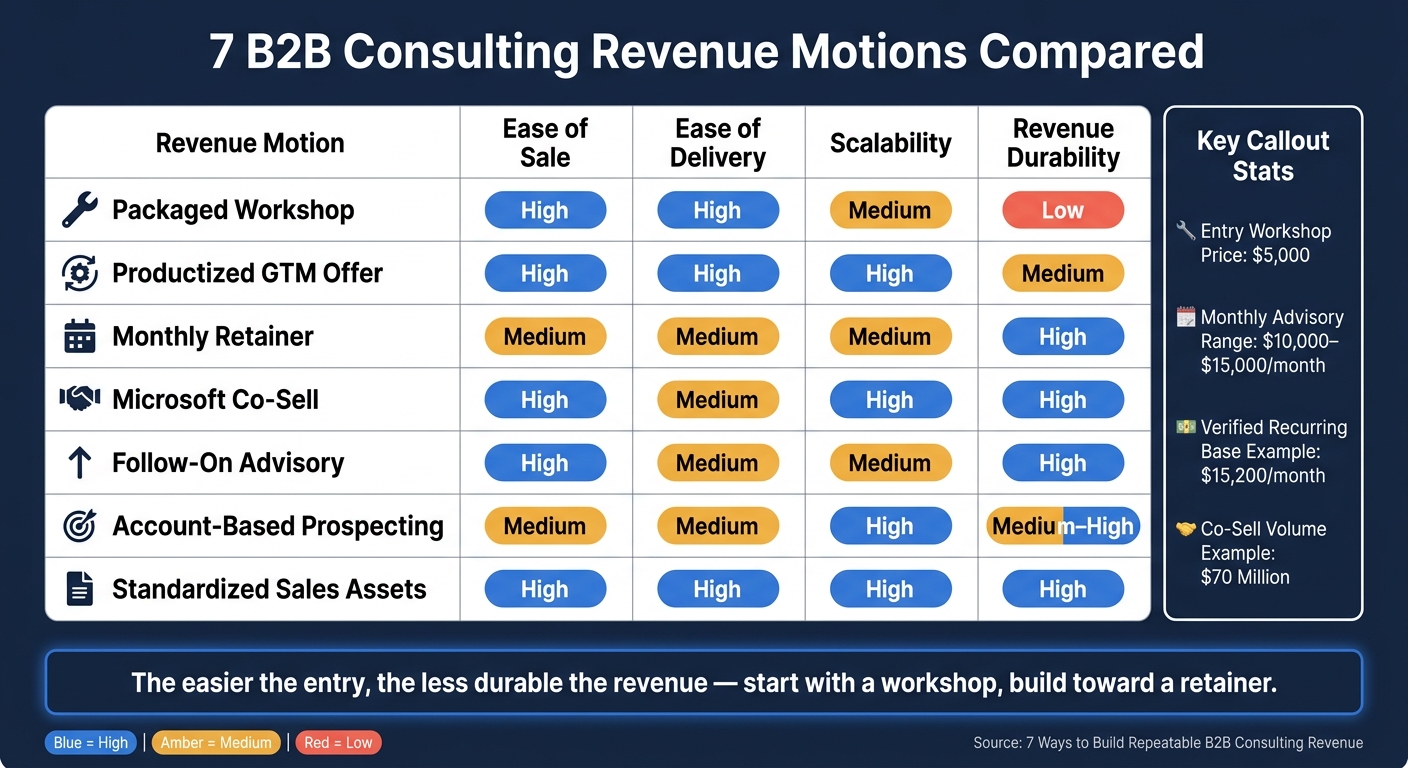 After laying out the seven motions, this snapshot makes the tradeoffs easier to see. It uses the same four lenses as above: ease of sale, ease of delivery, scalability, and revenue durability.
Here’s how the highest-leverage recurring motions compare:
| Revenue Motion | Ease of Sale | Ease of Delivery | Scalability | Revenue Durability |
|---|---|---|---|---|
| Packaged Workshop | High | High | Medium | Low |
| Productized GTM Offer | High | High | High | Medium |
| Monthly Retainer | Medium | Medium | Medium | High |
| Microsoft Co-Sell | High | Medium | High | High |
| Follow-On Advisory | High | Medium | Medium | High |
The big tradeoff is pretty simple: the easier the entry, the less durable the revenue tends to be. Workshops are the easiest way in. Retainers, on the other hand, tend to produce the most durable recurring revenue.
Microsoft Co-Sell can scale well, but only when the offer stays tightly tied to Microsoft seller priorities. If that fit slips, the motion can turn into busywork that doesn’t build pipeline.
Use this snapshot to pick the motion that matches your current stage. The next section turns that comparison into a simple starting move.
Conclusion
Repeatable consulting revenue doesn’t come from chasing one-off projects. It comes from turning consulting into a system. And when you look at these seven motions together - retainers, diagnostics, workshops, and co-sell - that shift starts to make sense.
If the offer is clear, the scope is fixed, and delivery stays under control, revenue can repeat.
The answer isn’t more hustle. It’s a motion that makes the outcome predictable from the start. Pick one motion - co-sell, diagnostic, or productized offer - and standardize it. Start with one motion, document the process, then add the next only after the first is repeatable.
FAQs
Which revenue motion should I start with first?
Start by turning the skills you already have into a clear B2B offer. Look at where your experience leads to business results, then match that to a specific gap in the market. Skip the generic playbook. Focus on the plain, concrete value your current skill set creates.
From there, zero in on the business problem you’re best equipped to solve for your buyer. That could be GTM architecture, pipeline strategy, or another high-stakes growth issue tied to revenue. When your offer solves a clear commercial problem and does it well, you have room to price at the top end of the market.
How do I turn a paid workshop into a monthly retainer?
Use the workshop as a structured discovery phase, then turn those one-time insights into a steady operating rhythm.
Position the retainer as an ongoing partnership. Focus on high-impact execution, work side by side with the team, track progress against monthly KPIs, and pass on skills and systems that stick. That creates a natural bridge from a one-off project to recurring support.
What makes a consulting offer truly repeatable?
A consulting offer becomes repeatable when it moves from one-off custom work to a systemized, product-like model that you control.
In plain English: instead of rebuilding the process for every client, you run a clear system with set steps, fixed sales assets, and a direct connection between what clients need and how you deliver it.
That usually includes documented workflows, predefined phases, and standardized outreach. The payoff is simple:
- Less scope creep
- Less dependence on outside teams
- More room to scale without pouring in endless hours
It’s the difference between making every project from scratch and working from a proven playbook.