
Co-Sell vs. Referral: Which Model Fits Your Firm
Referrals are low-effort for early pipeline; co-sell needs coordination but delivers repeatable, seller-backed enterprise deals.
If your team wants low effort, start with referrals. If you want a steadier pipeline and more Microsoft seller access, build a co-sell motion.
I’d make the choice based on three things: team bandwidth, deal complexity, and Microsoft seller access. In plain terms, referrals are easier to run, while co-sell asks for more coordination but gives you shared deal pursuit, more field support, and a better shot at repeatable pipeline.
Here’s the short version:
- Referral = Microsoft or another partner makes the intro, then you run the deal
- Co-sell = you and a Microsoft seller work the same deal together
- Referral fits early-stage sales teams and simpler services deals
- Co-sell fits firms with a sales owner, account mapping, and enough delivery capacity
- MACC and ECIF can push a deal toward co-sell
- The main tradeoff is simple: less work vs. more seller involvement
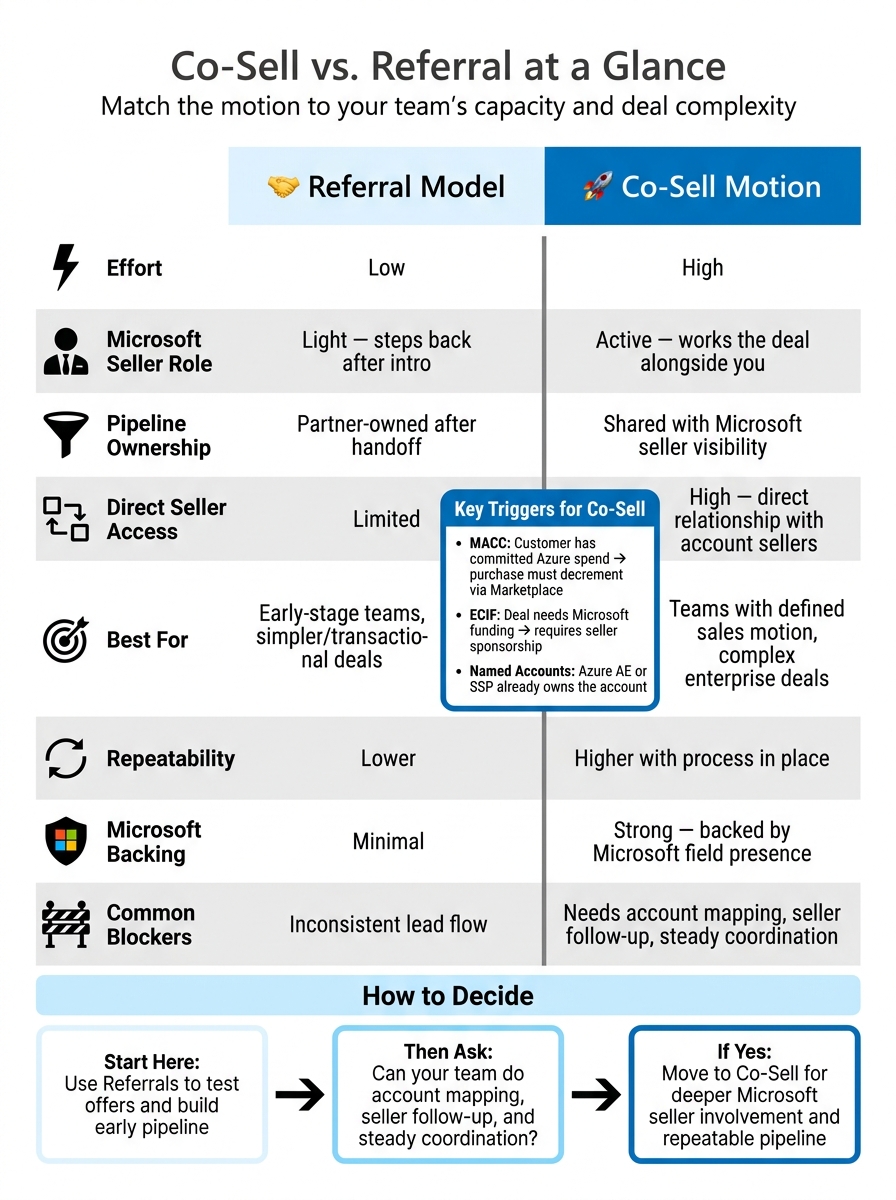
Referrals: Co-sell Deals vs Partner-led Deals
Quick Comparison
| Criteria | Referral | Co-sell |
|---|---|---|
| Effort | Low | High |
| Microsoft seller role | Light after intro | Active in the deal |
| Pipeline control | Partner-led | Shared |
| Best for | Early pipeline, simpler deals | Larger, more complex deals |
| Repeatability | Lower | Higher with process |
| Seller access | Limited | Direct access |
| Common blockers | Inconsistent lead flow | Needs account mapping and follow-up |
A simple way to look at it: referrals help you get started, while co-sell helps you scale once your sales motion is in place.
If I were deciding today, I’d use referrals to test and build pipeline first, then move into co-sell when the team can support account mapping, seller follow-up, and steady deal coordination.
Co-sell and referral: what each model means
Before putting these two side by side, it helps to define them in plain sales language. Not partner-program jargon. Just what they mean in practice. That difference shapes how much work each one takes and how much access it gives you to Microsoft sellers.
What a referral model means
A referral is a handoff. Microsoft or another partner introduces a prospect to your team. After that, your team runs the deal. Microsoft usually steps back once the intro is made.
This is a partner-led motion. Private referrals sent through the partner portal work the same way: you submit the opportunity, and your team owns the next steps. Co-sell begins where referrals end: with both sides working the same deal.
What a co-sell motion means
Co-sell is shared pursuit. Instead of getting a lead and handling it on your own, your team goes after a specific opportunity with a Microsoft seller. Both sides work the deal together. The motion depends on real seller activity, not just a portal submission. [1]
In day-to-day terms, that means mapping target accounts to named Microsoft contacts, finding relationship gaps, and keeping account context, talk tracks, and messaging ready for fast outreach in Teams or by email. Co-sell is not a one-time intro. It’s an operating rhythm between your team and Microsoft sellers.
The next section shows how each motion works inside Microsoft partner sales.
How each motion works in Microsoft partner sales
The mechanics are different enough that picking the wrong motion can slow a deal and burn time.
How referral flow works in partner-led sales
A referral motion usually starts when your team spots a good fit, submits or receives the opportunity in Partner Center, and handles qualification and follow-up on its own. Microsoft is usually only lightly involved unless the deal needs escalation. In most cases, Microsoft’s role ends after the handoff.
That’s what makes referrals simple. It’s also what limits them, which is where co-sell starts to matter.
How co-sell flow works with Microsoft sellers
Co-sell takes more prep work. Your team needs to map target accounts to Microsoft seller ownership - Azure Account Executives, SSPs, or other named contacts - and figure out where the account lacks a strong fit or where no direct Microsoft contact exists yet. From there, you create the opportunity in Partner Center and add account context, including talk tracks, messaging drafts, and a clear ask.
Microsoft sellers tend to respond faster when the partner shows up with a sharp account story, ready-to-send outreach, and a specific request. After that first touch, both sides stay in sync through regular updates and shared follow-through.
That extra work is the tradeoff, and it sets up the comparison that comes next.
Where Azure AE, SSP, ECIF, and MACC can change the motion

Some signals make a basic referral a poor fit. A MACC (Microsoft Azure Consumption Commitment) is one of the clearest examples. When a customer has committed Azure spend, they’re pushed to buy through the Azure Marketplace so that purchase can decrement the commitment. In practice, that often pulls the deal toward co-sell.
ECIF (End Customer Investment Funds) is another big trigger. If a deal needs Microsoft funding for an assessment or pilot, that funding needs Microsoft seller sponsorship and internal approval. That means a co-sell motion is required.
If your offer lines up with Microsoft priority areas, co-sell is often easier to justify. And when an Azure AE or SSP already owns the account, it helps to align early and shape the opportunity together.
Those triggers are a big reason the two motions play out so differently in the field.
Co-sell vs. referral: side-by-side comparison
The comparison below shows how each motion shapes effort, readiness, and Microsoft access. Use the table to weigh the tradeoffs that matter most: ownership, effort, and Microsoft access.
| Dimension | Referral Model | Co-Sell Motion |
|---|---|---|
| Seller Involvement | Low; Microsoft usually steps back after the intro. | High; Microsoft sellers actively work the deal. |
| Pipeline Ownership | Partner-owned after handoff. | Shared ownership and seller visibility. |
| Coordination Effort | Low. | High. |
| Direct Seller Access | Limited. | High; direct relationship with account sellers. |
| Typical Opportunity | Transactional services. | Complex advisory or implementation deals. |
| Microsoft Backing | Minimal. | Strong; backed by Microsoft’s field presence. |
| Repeatability | Less repeatable. | More repeatable with process. |
| Sales Maturity Fit | Best for early-stage teams. | Best for teams with a defined sales motion. |
That gap in effort is the main tradeoff.
The right choice depends on whether your firm needs simplicity or seller-enabled scale.
How to read the tradeoffs
Referrals are easier to get off the ground. They take less prep, less relationship management, and less reliance on Microsoft seller responsiveness. For firms still building their motion, or just testing whether a certain account segment is worth chasing, that can be a much better fit.
Co-sell takes more work, but it often makes more sense for larger, more complex enterprise services deals. The real split isn’t just deal size. It’s whether your team can do more than spot the right accounts. Can you also turn that signal into seller action, again and again? That’s where co-sell starts to pay off.
A simple way to think about it: referrals are lighter and easier to start, while co-sell asks for more coordination in exchange for deeper Microsoft seller involvement. Match the motion to your team’s current capacity and the size of the deals you’re aiming to win.
When each model fits and how to decide
Use the tradeoffs above as your filter. Start with your team’s capacity, then match the motion to the deal.
When a referral model fits better
Referrals make sense when you need a simple way to test a new offer or build early pipeline. It’s a good fit for firms that are still putting repeatable sales habits in place.
Choose referrals when you can’t rely on steady access to Microsoft sellers. It also fits when Microsoft seller follow-through is too light to support co-sell.
If a deal needs more Microsoft involvement than that, shift to co-sell.
When a co-sell motion fits better
Co-sell starts to make sense when your firm has a named sales owner, enough delivery bandwidth, and an active pipeline. It fits firms that need Microsoft backing to win bigger, more complex services deals.
Co-sell takes disciplined follow-up and steady Microsoft seller engagement. If your firm is going after named accounts, selling higher-value professional services, or needs Microsoft’s field presence to add buyer confidence, co-sell is the better path.
Map your target accounts to named Microsoft sellers first. If you can’t do that, co-sell will stall.
When your team can keep up that level of coordination, co-sell becomes the stronger motion.
Conclusion: pick the motion your team can actually run
The honest question isn’t which model sounds better. It’s which one your team can keep running without dropping the ball. Referral is the lower-effort path. Co-sell is the higher-alignment path. Neither works if you run it inconsistently.
The best motion is the one your firm can execute on a steady basis and measure in a clear way.
Start with referrals to build early pipeline, then move toward co-sell once your messaging, account mapping, and seller relationships are repeatable.
FAQs
How do I know when to move from referrals to co-sell?
Move from referrals to a co-sell motion when your firm is ready to stop waiting for leads and start building a repeatable pipeline with Microsoft field teams.
That shift tends to make sense when your team can run structured seller campaigns, go after specific accounts, keep outreach and follow-up steady, and line up sales and delivery with Microsoft seller incentives and account planning.
What internal roles do we need to run a co-sell motion well?
A strong co-sell motion needs dedicated roles that link your delivery teams with the Microsoft field organization.
The core roles usually include alliance leaders or partner managers, who handle seller relationships and account visibility, along with sales team members, who lead target account management, keep up regular seller engagement, support pursuits, and maintain the day-to-day co-sell rhythm.
How do MACC and ECIF change which model we should use?
MACC and ECIF often move firms beyond a passive referral model and into a more active co-sell motion.
Here’s why: ECIF can help spark Microsoft seller involvement, while MACC-backed deals can make your services easier to pitch because they help customers put their Microsoft cloud commitments to work.
That changes the sales motion. Instead of a light referral handoff, both programs usually need clear documentation and tight alignment with seller goals. In practice, that means teams need a structured, repeatable co-sell rhythm - not a casual, one-off approach.