
Corporate to Consultant: A Step-by-Step Income Plan
Build a repeatable side consulting income in 12 weeks with one clear offer, fixed-fee pricing, warm outreach, and repeatable delivery.
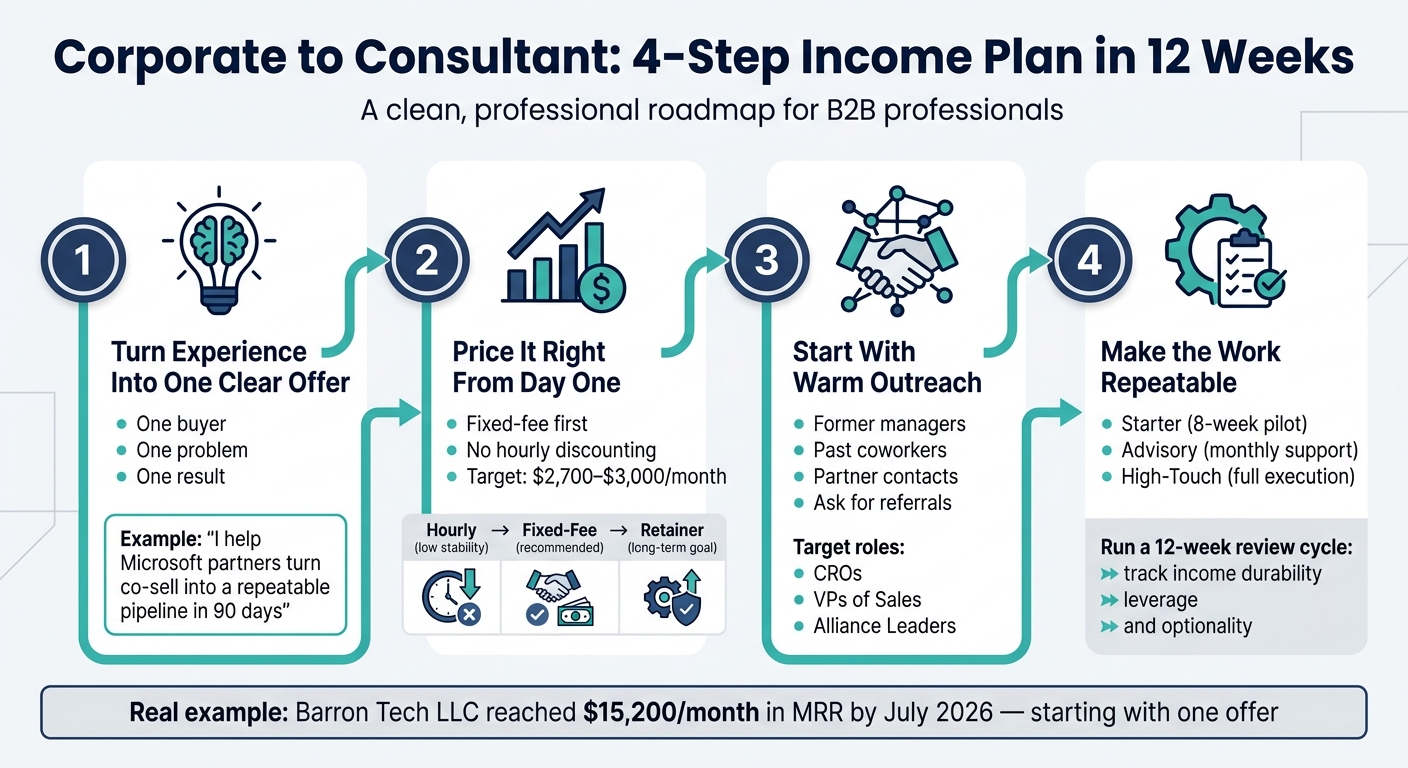
You do not need to quit your job to start consulting. If I already solve revenue, GTM, co-sell, or pipeline problems at work, I can turn that skill into a paid offer, test it over 12 weeks, and aim for a first side-income target of about $2,700 to $3,000 per month.
Here’s the short version:
- I start with one clear business problem I already know how to fix.
- I turn that into one simple offer for one type of buyer.
- I use fixed-fee pricing first, not cheap hourly work.
- I look for my first clients through people who already know my work.
- I keep delivery tight so the work does not take over my nights and weekends.
- I review the model every 12 weeks to see what sold, what renewed, and where my time went.
This article is about building a side consulting income in a low-drama way. It uses a B2B example from the Microsoft partner space, where Matt Barron grew Barron Tech LLC to $15,200 in monthly recurring revenue as of July 2026. The core idea is simple: keep your salary, test demand, then build something you own.
What matters most is not doing more things. It is doing one offer well, pricing it in a way that makes the work worth it, and talking to buyers before I need the income.
| Step | What I focus on | Main goal |
|---|---|---|
| 1 | Offer | Pick one buyer, one problem, one result |
| 2 | Pricing | Set a clear offer price and income target |
| 3 | Client outreach | Start with warm contacts and ask for calls |
| 4 | Delivery | Turn the work into a system I can reuse |
If I want more income options without making a big career move, this is the path: start small, sell one clear offer, and build from there.
How to Start a Consulting Business as a Side Hustle Without Quitting Your Job
Step 1: Turn your corporate experience into one clear consulting offer
Start with the work you already do best, then turn it into a paid business problem. You already fix issues that other companies would spend money to solve. The key is simple: can you describe that work clearly enough that someone outside your company would say yes to it?
List the business problems you already solve
Write down three to five problems, not job duties. Focus on what breaks, slows down, or gets stuck without you.
If you work in Microsoft partner sales or alliances, those problems might look like this:
- stalled co-sell pipelines
- weak account targeting
- sellers not acting on priority accounts
The best offers usually sit in the gap between strategy and execution. Many firms know which accounts matter. Far fewer have a system that gets sellers to act on that insight again and again [3].
Pick the problem you can explain the fastest and solve with the least confusion.
Pick a niche and write a one-sentence offer
Once you have your list, narrow it to one problem. A good niche names one buyer, one problem, and one result.
Use this formula: “I help [specific buyer] [solve specific problem] so they can [desired outcome].”
Here’s a strong example from the Microsoft partner space: “I help Microsoft partners turn co-sell into a repeatable pipeline in 90 days.” [2][4]
That line works because it tells people who it’s for, what it fixes, and how soon they can expect results.
Next, turn that sentence into a fixed-scope offer with a clear timeline, deliverables, scope, and outcome. Barron Tech, for example, uses a structured approach built around turning Microsoft referrals into a steady co-sell pipeline within 90 days [4]. That kind of tight scope is easier to sell and easier to deliver.
It also makes pricing and outreach much simpler in Step 2.
Step 2: Set pricing, income targets, and a low-risk starting plan
Once your offer is clear, the next step is practical: what should you charge, and what income target makes sense while you’re still getting a full-time paycheck?
Choose a simple pricing model
Most consulting work falls into three pricing models: hourly, project-based, and monthly retainer.
| Pricing Model | Speed to Sell | Ease to Define | Steady Income | Best Use Case |
|---|---|---|---|---|
| Hourly | Fast | Easy | Low | Quick troubleshooting or overflow work |
| Project (Fixed-Fee) | Medium | Moderate | Medium | Specific outcomes like an 8-week diagnostic or pilot engagement |
| Monthly Retainer | Slower | Hard | High | Ongoing strategic support, GTM execution, or “expert-in-your-corner” roles |
For most first-time consultants, fixed-fee work is the cleanest place to start. It gives you a clear scope, a clear outcome, and a much easier sales conversation.
This model works best when your offer is tight: one buyer, one problem, one outcome. That lines up with the niche statement you built in Step 1.
Start with a fixed-fee offer you can deliver without throwing off your day job. And don’t cut your price just to land early work. That often creates the wrong signal and makes the work harder to scope later.
Build a basic income scenario
Once you’ve set your price, turn it into a monthly target you can handle without stress. The good news? You don’t need a huge client roster for this to matter.
A monthly income target of $2,700 to $3,000 is a realistic starting point for one or two early engagements [4][5].
Keep it simple. Build a monthly target around one or two clients, then test that plan over 12 weeks. At this stage, the goal isn’t to squeeze out every dollar. The goal is to see if people will buy.
“Income reduces risk. Skills create leverage. Ownership creates optionality.” - Matt Barron, Founder, Barron Tech [1]
Set a 12-week target. Track your time, cash flow, and client load each week. That window gives you a clean way to check demand before you begin outreach.
Step 3: Find your first clients through warm outreach and focused targeting
Once your offer is clear, the next job is simple: find people willing to pay for it.
You do not need a big audience to get your first one or two clients. Use the 12-week test window from Step 2 to set up your first calls and see where interest shows up.
Start with people who already know your work
The fastest path is usually people who’ve already seen you do the job well. That could be former managers, past coworkers, founders you worked with, or Microsoft partner contacts. They don’t need a long explanation. They’ve already seen you fix the kind of problem your offer is built around.
Start with a short list of names. Then ask one question for each person: Have they seen me solve this problem? If the answer is yes, add them.
From there, send a short, direct note. Share what you’re building, explain your offer in one sentence, and ask for a brief call. If they know someone who could use help, ask for an intro. A warm intro will usually beat a cold message.
If your network doesn’t bring in enough calls, move to a tight target list built around the same offer.
Use a small outbound list and track follow-up
Put together a short list of Microsoft-focused services firms and partner leaders who own co-sell or GTM results. Aim your outreach at CROs, VPs of Sales, and Alliance Leaders. Those are usually the people who feel this problem most directly.
Keep your message tight. Mention the pain point tied to your Step 1 offer, connect it to the result you help deliver, and ask for a brief call. Then track it. A simple sheet is enough to log target accounts, contacts, gaps, replies, and follow-up.
| Outreach Method | Trust Level | Speed | Effort | Best Fit for a Side Consultant |
|---|---|---|---|---|
| Warm Outreach | High | Fast | Low | Best - leverages existing reputation |
| Referrals | High | Variable | Low | Great - high conversion, low volume |
Start at the top of the table and only go lower if you need more volume. For most people, warm outreach plus a few referrals is enough to get those first consulting conversations moving. Track replies, booked calls, and referrals so you can spot which message is landing.
Step 4: Deliver well, systemize the work, and build a repeatable income model
Landing your first client is a big win. But the next move matters just as much: make the work repeatable. If you don’t have a system, consulting turns into random projects that eat up your nights and weekends.
Package your work into repeatable services
The fastest way to stop scope creep is simple: quit building every engagement from scratch. Instead, set up a clear three-level service path based on where the client is right now.
| Offer Level | Service Type | What You Deliver |
|---|---|---|
| Starter | Audit / Pilot | One specific workflow, one KPI, fixed 8-week timeline |
| Advisory | Monthly Support | Ongoing co-sell operating rhythm, pipeline review, seller activation |
| High-Touch | Expert Help | Full campaign execution, Microsoft-focused newsletter support, pursuit support |
Start small: one workflow, one KPI, and an 8-week timeline. Then use that same ladder to move clients from a starter pilot into monthly support. Only move into high-touch execution when the scope actually calls for it.
That setup helps you keep delivery tied to the offer you sold in Steps 1 and 3.
Your clients shouldn’t have to babysit the project. They should get the outcome you promised, in the timeline you promised, without extra hassle.
Run a 12-week operating rhythm
Once you have one or two clients, you need a weekly structure that keeps delivery work and business development from crashing into each other. If you don’t, one of two things usually happens:
- You stop prospecting when client work gets heavy
- You let client quality slip when you’re chasing new leads
A better move is to separate delivery blocks from outreach blocks. That way, client work doesn’t swallow prospecting, and outreach doesn’t vanish when delivery gets busy.
Use a 12-week review cycle to see if the model actually repeats. Revenue matters, but it doesn’t tell the whole story. Track four checks: income durability, manual-effort exposure, leverage, and optionality.
A short weekly check-in on those four areas shows whether you’re building something with legs or just staying busy.
At the end of each 12-week cycle, look at what shipped, what renewed, what expanded, and where your time went. Cut the work that doesn’t repeat. Keep the work that renews. That’s how a side consulting practice starts to look like a repeatable income model instead of a loose pile of projects.
Conclusion: Start small, prove the offer, and build optionality over time
Moving from salary-only income to a real consulting income stream doesn’t call for some huge career leap. It starts with one narrow offer, simple pricing, and a system you can repeat. That’s what works.
A focused offer, premium pricing, and a repeatable delivery system can bring in meaningful income without leaving your job.
Build an income stream you control, and let your job pay for the first version.
Pick one offer, price it well, use warm outreach, deliver results, then standardize before you expand. That’s the sequence.
Your 9-to-5 isn’t the thing holding you back. It’s your buffer. It gives you room to build without panic. Use it that way. Spend the first 12 weeks proving demand, tightening the offer, and figuring out the next move.
FAQs
How do I know if my skill is marketable?
Your skill is marketable when it comes from five to ten years of deep B2B corporate experience and helps solve a specific, high-value business problem, like pipeline building, go-to-market strategy, or seller targeting.
Here’s the simple test: if your pay has leveled off but your work still plays a key role in revenue, there’s a good chance you have expertise that can be turned into a consulting offer.
What matters most is proof. The best way to validate that offer is to test whether your knowledge solves a real market need in a repeatable way.
What should I do if warm outreach gets no response?
If warm outreach gets no response, don’t panic or ditch your system. That’s a normal part of the process. You’re putting in the work, even if the payoff hasn’t shown up yet.
Stay the course. Keep doing your daily outreach, keep building your pipeline, and trust that results will catch up as you settle into a steady rhythm. Don’t freeze. When you stop the inputs, you only make the delay longer.
How many hours a week should side consulting take?
There’s no set number of hours for side consulting.
A better way to think about it is this: don’t aim for a weekly hour target just because it sounds good on paper. Base your time on your current role, your income, and your personal priorities.
The goal is to build a system you can keep up with, one that adds economic resilience and optionality without eating up your nights and weekends. That’s where an Economic Resilience Snapshot helps. Use it to figure out how much time you can actually give, then build a steady rhythm around that.
What matters most isn’t cramming in more hours. It’s sticking with repeatable inputs that compound over time.