
Dispute Resolution Clause Examples for B2B Services
Match your dispute-resolution format to your risk, privacy, and cost priorities—and make the next step airtight.
I’d start with one question: Where does the dispute go if talks fail? Your B2B services contract should name that forum, set deadlines, explain who pays, and preserve access to urgent relief.
I compare four clause formats:
- Mediation-first: Try to reach a settlement with a neutral mediator before going to court.
- Arbitration-first: Send disputes to a private arbitrator for a binding decision.
- Court venue: Name the courts where lawsuits must be filed.
- Tiered escalation: Move from project leads to executives, then mediation and a final forum.
Quick Comparison
| Format | Best fit | Privacy | Timing and costs |
|---|---|---|---|
| Mediation-first | Keeping a working relationship | Depends on legal and contract protections | Short deadlines help; failed mediation adds fees |
| Arbitration-first | A private, binding decision | Write confidentiality duties into the clause | Discovery limits may reduce costs; arbitrator fees apply |
| Court venue | Court discovery and judicial remedies | Records are often public | Court schedules, discovery, and motions affect costs |
| Tiered escalation | Giving teams a chance to settle | Depends on each stage and the final forum | Set a firm exit date so missed meetings cannot stall filing |
My drafting rule: make the next step clear. A 30-day mediation deadline, for example, should explain when the clock starts and what happens when it ends. I’d also check notice requirements, confidentiality, fee sharing, emergency relief, and filing deadlines.
These examples are starting points, not legal advice. Have a qualified U.S. attorney review the clause alongside the full agreement.
Governing Law and Dispute Resolution Clause Explained
Mediation-First Clauses
Mediation-first clauses suit scope, approval, and invoice disputes in B2B relationships where the parties want to keep working together. Mediation can resolve disagreements over fees, timelines, deliverables, or ownership without ending the engagement. The clause should spell out who starts mediation, who attends, how soon it happens, and where the dispute goes if mediation fails.
Sample Mandatory Mediation Clause
“Before filing litigation arising out of or relating to this Agreement, the parties shall attempt in good faith to resolve the dispute through mediation administered by the American Arbitration Association under its Commercial Mediation Procedures. The mediation may be conducted by videoconference unless the parties agree otherwise. Each party shall participate through a representative with authority to negotiate and settle. The parties shall share the mediator’s fees and administrative charges equally. Either party may commence mediation by delivering a written request describing the dispute. If the dispute has not been resolved within 30 days after the other party receives the written request, either party may bring the dispute in the exclusive courts located in [County, State], whether or not mediation has occurred.”
Fill in [County, State] to match the contract’s venue clause. Name the administrator and procedures; this sample uses the American Arbitration Association and its Commercial Mediation Procedures.[4] Require delivery of the mediation request under the contract’s notices provision, with a description of the dispute. Preserve access to emergency court relief. Separately, state that mediation does not pause limitation periods unless the parties sign a specific tolling agreement.[3]
Mediation Participation, Deadlines, and Confidentiality
Requiring participation goes further than a promise to attempt mediation. Assign responsibility for sending the request, selecting the mediator, and scheduling the session. Useful deadlines include acknowledgment within five business days and three proposed session dates within ten business days after receipt. Require a representative with authority to negotiate and settle to attend, and clarify whether counsel, technical advisers, insurers, or other representatives may join. Noncooperation should neither stop the 30-day clock nor prevent either party from filing suit once it expires.
Protect mediation communications, settlement proposals, mediation materials, and settlement discussions. The clause should bind the parties, their representatives, and the mediator, subject to applicable law and any disclosure needed to enforce a signed settlement.[2][6] Make clear that confidentiality does not automatically cover preexisting business records or independently discoverable evidence.
The tradeoffs are mediator fees, preparation time, and an extra step before suit. Splitting fees equally is simple, but state whether a separate fee-shifting provision changes that split.[5]
If mediation fails, the agreement must identify the next forum and the filing deadline.
Arbitration-First Clauses
Arbitration-first clauses give parties a private, final forum for B2B service disputes over scope, deliverables, or implementation work instead of court. Confidentiality and cost allocation must be written into the clause.
Sample Binding Arbitration Clause
“Any dispute, claim, or controversy arising out of or relating to this Agreement, including its formation, breach, termination, or validity, shall be finally resolved by binding arbitration administered by the American Arbitration Association under its Commercial Arbitration Rules. The tribunal shall consist of one arbitrator. The legal seat of arbitration shall be [City, State]. Hearings may be conducted remotely by agreement of the parties or as directed by the arbitrator. This Agreement is governed by the laws of the State of [State], without regard to its conflict-of-laws rules, subject to the Federal Arbitration Act to the extent applicable. Judgment on the award may be entered in any court having jurisdiction.”
Fill in both brackets, check the current rules, and specify any arbitrator qualifications and disclosure requirements. The seat determines the procedural law and supervising courts. Remote hearings don’t change it. Counsel should also align the seat, governing law, and enforcement provisions.
With the forum set, address discovery limits, costs, and when parties can still seek court relief.
Arbitration Discovery, Fees, and Emergency Relief
Set discovery limits expressly. Consider proportional document exchange and no more than two depositions per side, with more discovery allowed when the arbitrator finds it necessary and proportional.[5] For claims under $100,000, use documents-only submissions or an expedited hearing. Define how counterclaims count toward that threshold. For remote hearings, address exhibits, witness authentication, and recording.
Spell out who pays administrative charges, arbitrator compensation, hearing costs, and attorneys’ fees. State who makes initial payments, whether the award may reallocate costs, and which contractual, statutory, or rules-based grounds allow attorneys’ fee awards.
Add express confidentiality duties for submissions, evidence, testimony, and awards. Include exceptions for legally required disclosures, advisers, insurers, or enforcement. Privacy alone doesn’t create confidentiality duties, and court enforcement may make information public.
Preserve access to temporary court relief without waiving arbitration of the merits. Also state whether emergency-arbitrator procedures apply. Keep any injunctive-relief exception narrow so it doesn’t unintentionally move the merits into court.
The tradeoffs include potentially high neutral and legal fees, less discovery, and limited judicial review. Ordinary factual or legal errors rarely justify vacating an award under the FAA.[1][7] Before signing, have counsel review enforceability, statutory claims and remedies, emergency relief, required disclosures, and any consumer rules that apply despite the B2B label.
Court Venue Clauses
Choose a court venue clause when you want formal discovery, subpoenas, and judicial remedies, including injunctive relief, rather than private dispute resolution. This format also lets you name a specific state or federal court. For B2B services, it may cover disputes over unpaid invoices, work-product ownership, confidentiality breaches, non-solicitation obligations, or requests for injunctive relief. Before committing both parties to one forum, check travel costs and witness locations.
Sample Exclusive Court Venue Clause
“Any action or proceeding arising out of or relating to this Agreement shall be brought exclusively in the state courts located in [County], [State]. If federal subject-matter jurisdiction exists, the action or proceeding may be brought exclusively in the United States District Court for the [District] of [State]. Each party consents to the personal jurisdiction of those courts and waives any objection based on inconvenient forum or improper venue, to the extent permitted by applicable law. This Agreement is governed by the laws of the State of [State], without regard to its conflict-of-laws rules.”
Venue and governing law are separate choices. Venue determines where litigation happens; governing law determines which substantive law applies. Replace every bracketed placeholder and have counsel check the county, state-court system, federal district, and enforceability.
Forum selection sets venue and records each party’s consent to personal jurisdiction. It does not create federal subject-matter jurisdiction. Federal court still requires an independent basis, such as a federal question or qualifying diversity jurisdiction.[8][9]
Federal Removal and Temporary Court Relief
Use exclusive language to require suit in the named courts. Use nonexclusive language to allow suit there without ruling out other lawful forums. Match the federal district to the selected county.
If removal remains available, expressly preserve that right, subject to applicable law. Naming a federal court does not make removal automatic.[9]
Keep any temporary-relief exception narrow. For example, it might allow temporary relief to prevent imminent and irreparable harm, such as disclosure of confidential information, while keeping the underlying dispute in the selected forum.
Compared with arbitration, this format offers broader discovery and public enforcement, but less privacy. Court discovery and compulsory process can help establish facts. The tradeoffs are expense, travel, and public proceedings that may expose pricing, customer information, or proprietary methods. Before choosing this format, weigh likely litigation costs against the amount at stake and any contractual liability cap.
Tiered Escalation Clauses
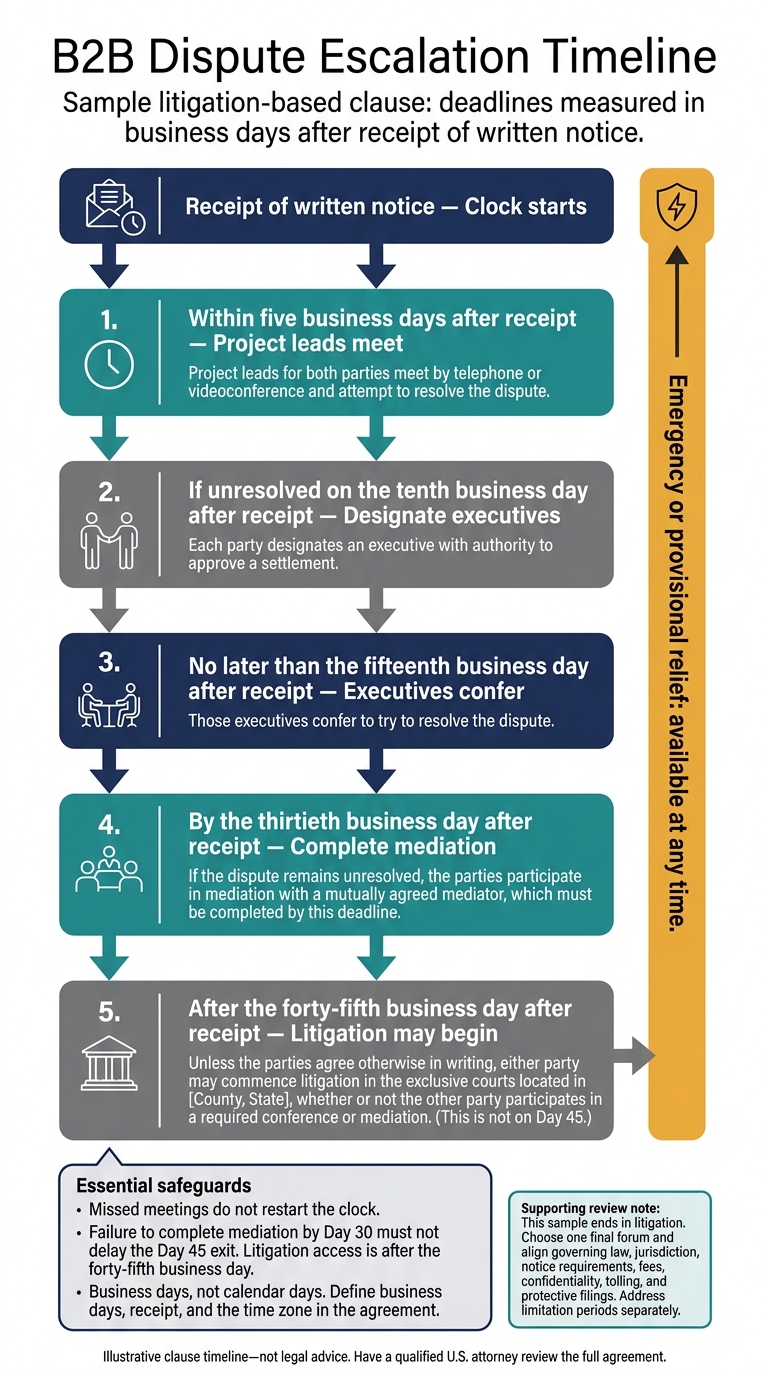 Use tiered escalation for recurring consulting, managed services, or implementation work. Day-to-day teams can handle scope issues, while executives can resolve disputes over payment, delivery, or renewal.
Sample Project-to-Executive Escalation Clause
Tiered Escalation. Either party may initiate this process by delivering written notice describing the dispute and requested relief. Within five business days after receipt, the project leads for both parties shall meet by telephone or videoconference and attempt to resolve the dispute. If the dispute remains unresolved on the tenth business day after receipt, each party shall designate an executive with authority to approve a settlement, and those executives shall confer no later than the fifteenth business day after receipt. If the dispute remains unresolved, the parties shall participate in mediation with a mutually agreed mediator, which must be completed by the thirtieth business day after receipt. Unless the parties agree otherwise in writing, either party may commence litigation in the exclusive courts located in [County, State] after the forty-fifth business day after receipt, whether or not the other party participates in a required conference or mediation. Either party may seek emergency or provisional relief at any time.
Escalation Roles, Deadlines, and Final Forum
This structure gives project teams a chance to resolve issues, puts settlement decisions in executives’ hands, and sets a firm deadline for access to the final forum.
Specify the exclusive state or federal courts, county and state, governing law, consent to personal jurisdiction, and service of process. Also address any intended jury-trial provisions and whether federal removal is preserved. Define business days, receipt, the time zone, and whether earlier steps are conditions precedent to filing.[12][13][14]
Spell out settlement authority, attendance rights, fee splits, and what happens if someone misses a meeting. Missed meetings do not restart the clock. Failure to complete mediation by Day 30 must not delay the Day 45 exit.
Choose one final forum: arbitration for private finality, or litigation when court discovery and judicial remedies matter more. Address tolling, protective filings, and any suspension or termination rights separately.[10][11]
Conclusion: Choose a Format and Get Legal Review
Choose a format based on the dispute’s value, the business relationship, privacy needs, urgency, discovery, and enforcement.
Compare the 4 Clause Formats
Use this matrix to match each clause format to your top business priority.
| Format | Privacy | Formality | Speed | Cost control | Relationship preservation | Access to injunctive relief |
|---|---|---|---|---|---|---|
| Mediation-first | Depends on the agreement and applicable law | Low to moderate | Fast with short deadlines and participation from both parties | Early settlement can save money; unsuccessful mediation adds fees | Strong; parties control the settlement | Requires a separate court or arbitration provision |
| Arbitration-first | Private proceedings; confidentiality depends on the clause or rules | Moderate to high | Depends on scheduling and complexity | Discovery limits can control costs; administrative and arbitrator fees apply | Less public conflict, but the outcome is imposed | Emergency arbitrator or court |
| Court venue | Greater exposure through public records | High | Depends on the court’s docket and discovery | Predictable court fees; discovery and motions drive costs | Adversarial process | Established court procedures |
| Tiered escalation | Depends on the final forum and each stage | Informal to formal | Depends on the final forum and deadlines for each step | Early settlement can save money; extra steps add costs | Strong for continuing business relationships | Requires an express emergency-relief exception |
Contract Review Checklist
Once you’ve picked a format, review the terms that control enforceability.
- Coverage: Define covered claims and exclusions.
- Process: Check governing law, forum, rules, and filing prerequisites.
- Logistics and costs: Address location, remote participation, language, neutral selection, fees, deposits, and fee shifting.
- Protections: Review confidentiality, document exchange, emergency relief, limitation periods, tolling, and award enforcement.
- Consistency: Check alignment with notice, payment, termination, intellectual-property, indemnity, and liability provisions.
Consulting Offer Design and Legal Review
Clear deliverables, acceptance criteria, payment dates, and change-order procedures help reduce disputes in B2B consulting offers. Have a qualified U.S. attorney review the full agreement before signing.
FAQs
Can I change the dispute clause after signing?
Once a contract is signed, its dispute resolution clause is binding and generally can’t be changed by one party alone. Changes typically require a formal written amendment that both parties agree to and sign.
You can update internal procedures or service terms for future engagements. But existing signed agreements remain governed by their original wording unless both parties sign an amendment.
What if my client operates in another state?
Your contract should spell out both governing law and venue: which state’s laws apply and where disputes will be resolved.
For example, Barron Tech contracts are governed by Texas law, without regard to conflict-of-law principles.
Work with legal counsel to make sure these provisions are enforceable and fit your business arrangements.
Should I exempt small unpaid invoices from arbitration?
There’s no one-size-fits-all rule. Exempting small unpaid invoices from arbitration lets you pursue them in small claims court, which is often faster and less expensive. Arbitration fees can sometimes exceed the invoice amount.
Before you decide, review your usual billing procedures. Then clearly state the dollar threshold for the exemption in your contracts so there’s no confusion.