Income Durability: What It Means and How to Track It
Income durability is about structure—track seven monthly metrics to spot your weakest income source and strengthen your financial resilience.
Your income is only as strong as its weakest source. I’d judge income durability by how long my earnings can keep going if one source drops, not by salary alone.
Here’s the short version:
- If 1 client, employer, or channel drives most of my income, risk is high.
- If I have more recurring income, more than 1 source, and at least 6 months of savings, my setup is harder to knock over.
- I can track income durability with 7 simple numbers:
- Income concentration
- Recurring revenue mix
- Pipeline coverage
- Renewal rate
- Average client tenure
- Savings runway
- Channel dependence
- Common warning signs are:
- More than 70% of income from one source
- Less than 20% recurring revenue
- Less than 2 months of pipeline coverage
- Less than 3 months of savings runway
- More than 80% of revenue tied to one channel
A person earning $180,000/year from one job may be in a weaker spot than someone earning $150,000/year from salary, retainers, and side work. That’s because durability is about structure, not just total dollars.
I’d use this article as a simple scorecard: measure the 7 numbers each month, find the biggest weak point, and fix that first.
I Lost Everything. Then I Learned This 1 Financial Rule.
What makes income more or less durable
Not all income works the same way. A paycheck that lands every two weeks can seem steady - right up until it stops. What makes income durable is simpler than it sounds: does it repeat, is it spread across more than one buyer, and can you see where the next dollar is coming from?
In plain English, durability comes down to repeatability, diversification, and forecast visibility.
How salary, retainers, projects, partner-led services, and side income compare
Each income type has its own durability profile.
Salary ranks high for recurrence. You know when the money is supposed to hit. But it also comes with the biggest concentration risk: one employer. If that one source disappears, the whole stream disappears with it.
Consulting retainers can feel a lot like salary in terms of repeat business, but with less concentration risk. You’re not tied to a single employer. That said, retainers can weaken fast if scope starts drifting or your delivery system is shaky.
Project work is the most fragile of the group. It usually has low recurrence, low pipeline visibility, and a strong boom-and-bust pattern in cash flow [1].
Partner-led services fall somewhere in the middle. Recurrence is often medium to high, but channel dependence can become a problem. And even when revenue looks solid on paper, Net-30 to Net-90 payment terms can squeeze cash flow hard [3].
Side income is the least steady. It can help diversify your total income mix, which is useful. But high customer acquisition costs and uneven deal flow make it weak as a standalone base [1][4].
| Income Type | Recurrence | Concentration Risk | Pipeline Visibility | Main Failure Points |
|---|---|---|---|---|
| Salary | High | Highest (single employer) | High | Layoffs, automation exposure |
| Consulting Retainers | High | Low/Medium | High | Scope creep, weak delivery systems |
| Project Work | Low | High (per project) | Low | Boom-and-bust cash flow |
| Partner-led Services | Medium/High | Medium (channel dep.) | Medium | Payment lags, procurement delays |
| Side-business | Variable | Low (diversified) | Variable | High CAC, inconsistent deal flow |
The big point here is that durability doesn’t come from the label alone. Two people can both say they do “consulting” and still have very different risk profiles.
The structural traits behind durable income
Once you compare income types, the next step is to look at the traits underneath them. That’s where the pattern shows up.
Recurring revenue beats one-time revenue. A recurring contract gives you visibility. A one-off project sends you back to zero after every deal. You have to sell again, scope again, and hope the pipeline fills back up.
Signed commitments matter. A client with a clear contract is more durable than one running on loose promises and “we’ll figure it out.” Clear scope, payment terms, and renewal terms make income less fragile.
More than one source helps. Two or three separate income sources lower the odds that one disruption takes everything out at once. You’re still exposed to risk, just not all in one shot.
Savings runway matters too. Think of it as a shock absorber. When income drops, runway gives you time. Time to replace a client. Time to fix terms. Time to avoid making rushed choices when cash gets tight.
Next, measure those traits with simple monthly metrics.
The core metrics to track income durability
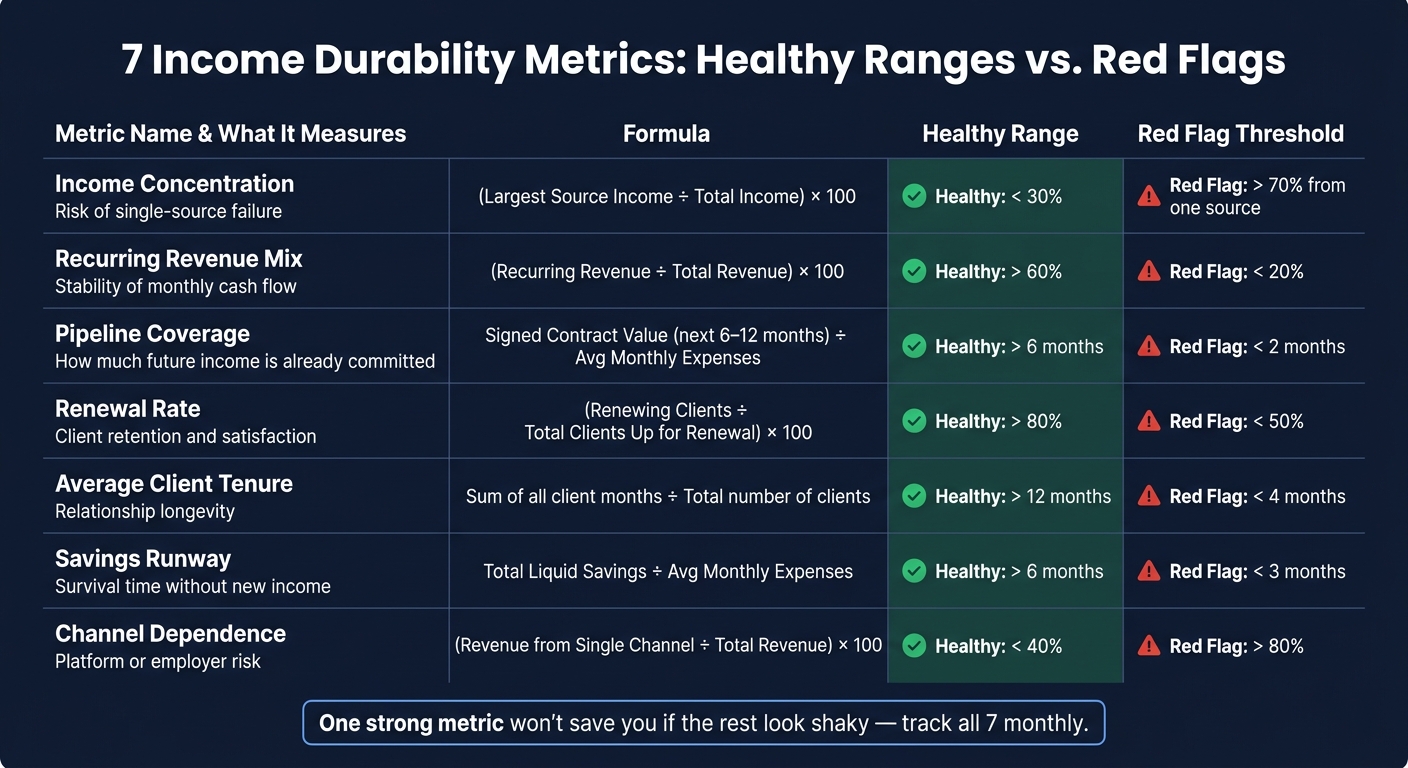
The 7 numbers that show how durable your income is
You can boil income durability down to seven monthly numbers.
These metrics show whether your income can hold up through client churn, layoffs, platform changes, or swings in demand. In plain terms: if something goes sideways, do you have enough stability to absorb the hit?
Income concentration by source shows how much of your total income comes from one client, employer, or product line. If that one source disappears, how much income disappears with it?
Recurring vs. one-time revenue mix separates steady cash flow from income you have to win again every month. It helps you see how much of your income is already repeatable.
Contract pipeline coverage looks ahead 6 to 12 months and asks how much future income is already under contract. Renewal rate shows whether clients decide to stay, which is a direct signal that your work matters to them. Average client tenure tracks how long those relationships tend to last.
Savings runway measures how many months of expenses you could cover with liquid savings alone if new income stopped. Channel dependence shows how much revenue relies on one employer, buyer, or platform.
Seven numbers cover most of the risk.
How to calculate each metric and what risk levels to watch
The math here is simple. These metrics work across salary, retainers, project work, partner-led services, and side income.
Don’t read any one number by itself. The pattern across all seven tells the story.
| Metric | What It Measures | Simple Formula | Healthy Range | Red Flag |
|---|---|---|---|---|
| Income Concentration | Risk of single-source failure | (Largest Source Income ÷ Total Income) × 100 | < 30% | > 70% from one source |
| Recurring Revenue Mix | Stability of monthly cash flow | (Recurring Revenue ÷ Total Revenue) × 100 | > 60% | < 20% |
| Pipeline Coverage | How much future income is already committed | Signed Contract Value for next 6–12 months ÷ Average Monthly Expenses | > 6 months | < 2 months |
| Renewal Rate | Client retention and satisfaction | (Renewing Clients ÷ Total Clients Up for Renewal) × 100 | > 80% | < 50% |
| Average Client Tenure | Relationship longevity | Sum of all client months ÷ Total number of clients | > 12 months | < 4 months |
| Savings Runway | Survival time without new income | Total Liquid Savings ÷ Average Monthly Expenses | > 6 months | < 3 months |
| Channel Dependence | Platform or employer risk | (Revenue from Single Channel ÷ Total Revenue) × 100 | < 40% | > 80% |
Think of the table as a risk map. One strong metric won’t save you if the rest look shaky. Broad weakness is the bigger warning sign.
Use a simple monthly scorecard instead of overbuilding spreadsheets
You don’t need a complicated model. You need a habit you’ll stick with.
Once a month, pull these seven numbers and look for movement, not perfection. For example, if your renewal rate falls from 85% to 71% over two months, that matters more than whether it lands on some exact target this week.
The point is to spot trend shifts early, before they turn into cash flow trouble. Barron Tech’s Economic Resilience OS can help you track these seven metrics on a monthly cadence.
“Income reduces risk. Skills create leverage. Ownership creates optionality.” - Barron Tech [2]
Start with concentration and runway. Then layer in the rest.
How to assess durability in B2B consulting and partner-led revenue
What durable consulting income looks like in practice
These seven metrics apply straight to consulting income. And in most cases, risk shows up in a few familiar spots.
The most common pattern is simple: one big client drives most of the revenue. If a single client makes up around 70% of revenue, concentration is high [1]. That’s a red flag. Check concentration every month, and use an equal-weight view so one large deal doesn’t mask how dependent the business has become.
Durable consulting income usually has a solid share of retainers or annual contracts, paired with high renewal rates. That mix matters. Retainers turn one-time projects into recurring cash flow. Renewals show that clients still see value after the first engagement. When there’s no clear next step for the client, average client tenure tends to slip.
The main metrics to track here are:
- Income concentration
- Recurring revenue mix
- Renewal rate
- Average client tenure
The same thinking carries over to partner-led revenue. The difference is where concentration shows up. Instead of clients, the risk often sits with sellers, programs, or channels.
How to judge the durability of partner-led and Microsoft co-sell services revenue
Partner-led revenue comes with a different set of risks, but the same durability metrics still work.
The biggest danger is single-partner dependence. That happens when one Microsoft seller, referral partner, or co-sell program generates most of the pipeline. Use an equal-weight view - one vote per partner or seller - to see whether momentum is spread out or piled into a small number of accounts [1].
Weak account coverage can make the pipeline look healthier than it is. So can short-lived program spikes. Both can create the illusion of strength. Durability gets better when partner motion is built into steady seller relationships and backed by regular follow-up.
The main metrics to watch here are channel dependence, pipeline coverage, and seller ownership across accounts.
Build a stronger income durability plan
A 30-day plan to find weak points and improve resilience
Once you have the scorecard, use it to pick one clear move for this month.
Start by placing each income source into a bucket. Do it once, and use one definition for each source so your numbers stay clean. Then calculate the seven metrics.
If a single client, employer, or channel brings in the biggest share of your income, that’s the first risk to cut down. It’s the biggest weak spot, so deal with that first. After that, work on stretching your savings runway and turning one project into a retainer.
The goal is simple: fix the largest weak point first, then keep the monthly review in motion.
Where Barron Tech fits if you want a system, not just a checklist

If you want a repeatable way to handle that monthly review, Economic Resilience OS takes the monthly scorecard and turns it into a 12-week workflow with a snapshot and weekly check-ins.
It begins with a snapshot. Then it uses weekly check-ins to keep the numbers up to date.
For partner-led revenue, Co-Sell Buddy tracks seller ownership across accounts and flags gaps in pipeline coverage.
FAQs
How often should I track income durability?
Track it every week. A steady weekly check-in helps you spot weak points early, see the tradeoffs, and make adjustments as market conditions or revenue sources shift.
Use annual reviews, or moments of major change, for bigger calls about roles or business structure. Weekly tracking keeps your pipeline, client tenure, and dependency levels in view in near real time.
Which metric should I improve first?
Start with income concentration. If most of your money comes from one employer, one buyer, or one channel, that’s a clear weak spot. Income lasts longer when it isn’t tied too tightly to a single source.
Once you’ve sized up that risk, make a savings runway your next move, such as six months of expenses. After that, work on your revenue mix and retention rates so your income base gets steadier and you have more room to choose your next step.
Can a salary count as durable income?
Yes. A salary can count as durable income because it gives you steady, predictable cash flow.
That said, there’s a catch: if all of that income comes from one employer, your setup has a weak spot. A layoff, company trouble, or shifts in your industry can hit your finances all at once.
To make that income hold up better over time, keep an eye on how much you depend on that single source. Then look for ways to add backup income, like consulting, freelance work, or another side stream. That gives you more resilience and more room to move if your main job changes.