
Partner-Led Growth vs. Direct Sales: Key Differences
Compare control, cost, speed, and scale between direct sales and partner-led growth to choose the right GTM motion.
If you want more control, use direct sales. If you want more reach without hiring a big sales team, use partner-led growth. That’s the short answer.
I’d break it down like this:
- Direct sales = your team owns prospecting, meetings, pricing, and close
- Partner-led growth = partners, resellers, SIs, or Microsoft sellers help source or move deals
- Direct sales works best for high-ACV deals, early offers, and sales that need tight message control
- Partner-led growth works best when your offer is proven and easier to repeat
- A hybrid model fits when you want your AEs on key accounts while partners help expand pipeline
In plain terms, this choice shapes:
- Pipeline source
- Sales cost
- Deal speed
- Scale
- Margin
- Follow-up ownership
A common pattern is simple: early-stage firms often start with direct sales to learn fast, then add partner-led growth after the offer is easier to sell. In Microsoft-focused B2B, that usually means moving from founder-led or AE-led outreach into some level of co-sell motion.
Direct vs. Indirect Partners: Who Wins Under Microsoft FY26 Rules?
Quick Comparison
| Factor | Direct Sales | Partner-Led Growth |
|---|---|---|
| Who drives the sale | Your internal team | External partners and Microsoft sellers |
| Control | High | Lower |
| Fixed sales cost | Higher | Lower |
| Access to accounts | Limited by team size | Broader through partner relationships |
| Best for | Complex deals, early offers, tight runway | Proven offers, repeatable sales, partner channels |
| Main risk | Sales-delivery mismatch | Poor follow-through after planning |
I see the choice as a tradeoff between control and reach. If you need close oversight, direct sales usually fits. If you need account access and lower headcount pressure, partner-led growth can make more sense. And if you sell into large Microsoft accounts, a mixed model is often the most practical path.
How Direct Sales Works
In a direct sales motion, your internal team runs the whole sales cycle - from prospecting and discovery to solution design, proposals, and close. Early on, founders often lead deals because they carry the vision and can answer tough questions on the spot. As the company grows, AEs usually take over named accounts, using account maps and relationship maps, while SDRs help with outreach and account research. That setup matters most when the seller needs fast feedback from the market.
Where Direct Sales Wins: Control, Learning Speed, and Complex Deals
Direct sales gives you full control over qualification, pricing, and positioning.[3] Because direct sellers stay closer to delivery, they hear customer pain points sooner and can adjust faster.[4] That makes direct sales a strong fit for complex, high-end offers where specialized expertise sits at the center of the sale.[6] The flip side is simple: your internal team has to do more of the work.
Microsoft Example: Founder-Led or AE-Led Outreach into Named Accounts
Take Echelix as an example. The company sells AI agent deployments on Microsoft Azure with a founder-led pilot motion into industrial accounts.[5] Its sales motion used an 8-week, fixed-price “Embedded Agent Pilot” as the entry offer, with on-site discovery to define specific KPIs and set up the right agentic workflows. That level of control is a big strength in direct sales. But it also puts a limit on how far one team can scale on its own. That’s why teams often weigh direct sales against partner-led growth.
How Partner-Led Growth Works
In partner-led growth, outside partners help source, shape, or close the deal. That partner may be a referrer, reseller, SI, or Microsoft seller. [3][7]
Where Partner-Led Growth Wins: Reach, Leverage, and Lower Fixed Selling Cost
Partner-led growth gives up some direct control in exchange for more reach. That’s the main upside.
A small internal team can only get in front of so many accounts. But if you line up with Microsoft field sellers across Azure, M365, Security, and Dynamics, you can get access to named accounts and warm introductions. It can also lower fixed selling cost, since you’re not depending only on a larger in-house front-line sales team. [1][3][5]
That said, the tradeoffs are real. You may have less control over how your solution is positioned. Partner enablement takes time. And partner fees or revenue share can cut into gross margins. The leverage is there, but it comes with a price. [1][3]
In the Microsoft ecosystem, this tends to show up most clearly in co-sell motions.
Microsoft Co-Sell Example: Partner Alignment, Account Mapping, and Shared Pursuit
In a Microsoft co-sell motion, the first step is seller alignment. That usually means finding the field sellers who cover your target accounts, then mapping partner relationships to see where coverage is thin and where the relationship is strong. [1][3]
From there, joint pursuit planning begins. Teams coordinate outreach through shared channels, attach account context and clear talk tracks to each task, and set up opportunity registration so both sides stay lined up through close and revenue attribution. As Matt Barron, Founder of Barron Tech, puts it:
“Make it easy for me.” [5]
That idea matters because Microsoft sellers are busy. Barron Tech supports this motion with Microsoft GTM consulting and a co-sell operating rhythm built around heatmaps, seller campaigns, pre-drafted outreach, and clear follow-up ownership. [3]
When the next step is obvious, sellers tend to respond faster.
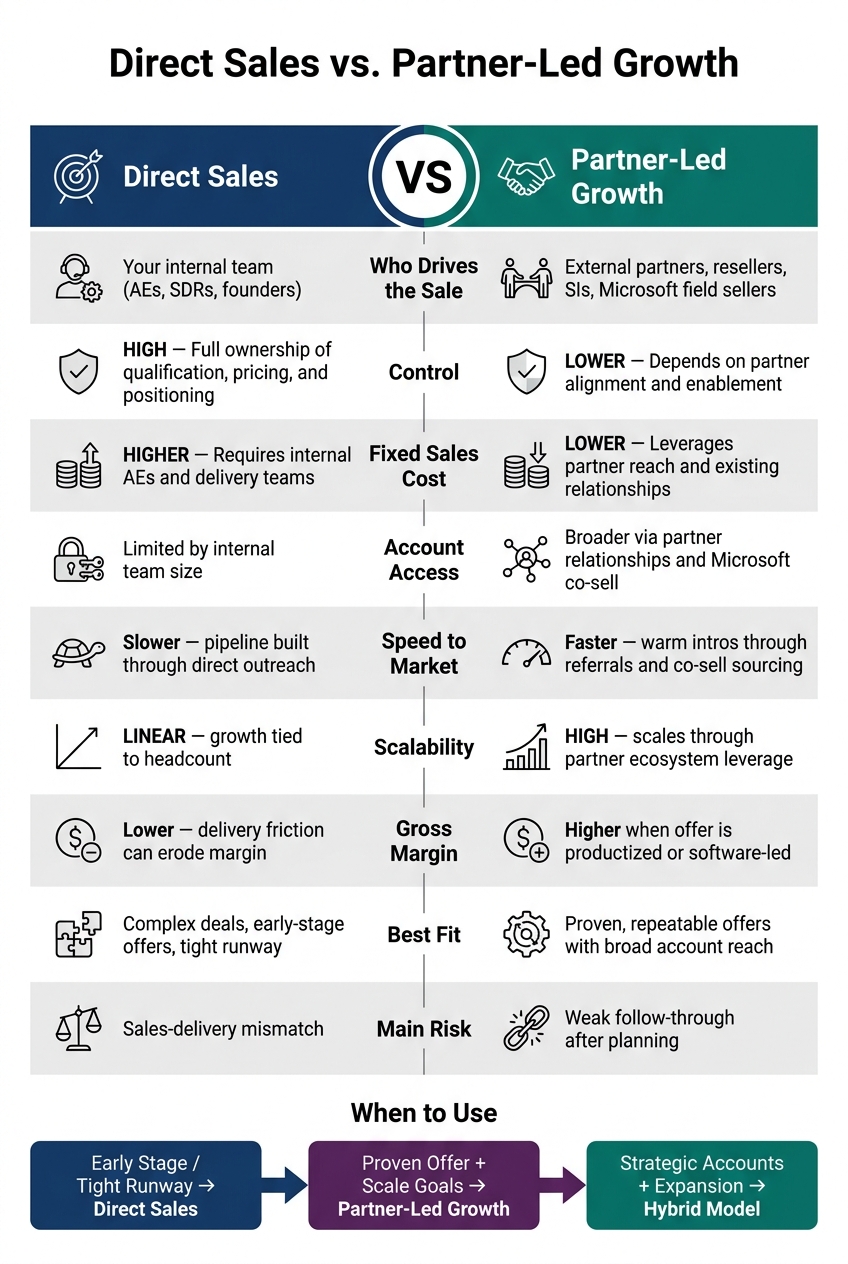
Partner-Led Growth vs. Direct Sales: Side-by-Side Comparison
These two motions differ in a pretty basic way: who owns pipeline, control, and scale. For Microsoft-focused firms, that often plays out as direct outreach on one side and co-sell execution on the other.
The table below lays out the main tradeoffs. At the core, the choice often comes down to this: Do you want more control, or more reach?
Control, Cost, Speed, Scalability, and Margin
| Factor | Direct Sales | Partner-Led Growth |
|---|---|---|
| Control | High; the seller owns the full sales cycle [4] | Lower; success depends on alignment with external field sellers [1] |
| Cost | Higher fixed selling costs; requires internal AEs and delivery teams [1] | Lower fixed costs; leverages partner reach and existing relationships [1] |
| Speed | Slower; building a direct pipeline takes time and headcount | Faster access to market through partner referrals and co-sell sourcing [1][3] |
| Scalability | Linear; growth is limited by internal headcount | High; scales through partner ecosystem leverage [1][3] |
| Gross Margin | Lower; services value compression and delivery friction can erode margin [4] | Higher when delivery is productized or software-led [4] |
| Best Fit | High-complexity deals with direct seller control | Repeatable deals that benefit from partner access |
Pipeline Creation and Seller Alignment in Each Model
Pipeline mechanics are where the biggest day-to-day difference shows up.
| Pipeline Mechanic | Direct Sales | Partner-Led Growth (Co-Sell) |
|---|---|---|
| Source of Pipeline | Outbound prospecting, curated lead lists, and inbound interest [2][8] | Partner referrals, account mapping, and heatmap coverage [1][3] |
| Who Owns Follow-Up | Internal AE, end to end | Shared across internal and partner reps; requires clear task ownership [3] |
| Account Mapping Needs | Internal CRM and seller-managed named accounts | Shared heatmaps identifying coverage gaps and relationship depth [3] |
| Seller Incentives | Direct commission tied to contract value | Often tied to partner program metrics [5] |
| Common Execution Risk | Mismatch between what was sold and what delivery can execute [4] | Weak follow-through after planning [3] |
Direct sales is easier to run because one team owns the motion from start to finish. But there’s a catch: reach tends to stop where your team stops.
Partner-led growth gives you more leverage. You can get into accounts faster through referrals, mapped accounts, and co-sell support [1][3]. But that only works if follow-up is tight. If reps on both sides aren’t clear on next steps, deals can stall out fast.
In co-sell, the main risk usually isn’t the plan. It’s execution after the plan is made. Account context can get lost across tools and across companies, which is why attaching talk tracks and outreach drafts straight to seller tasks matters more than the planning doc itself [3]. That’s the tradeoff behind the choice between direct sales, partner-led growth, or a hybrid model.
When to Use Direct Sales, Partner-Led Growth, or Both
Pick the motion that matches your ACV, deal complexity, and runway.
How to Choose Based on ACV, Deal Complexity, and Runway
Start with direct sales when you need fast customer feedback and close control over delivery. This matters most with early-stage offers, high-complexity deals, or when runway is tight and you need revenue soon.
Use partner-led growth once the offer is proven and repeatable. At that stage, Microsoft co-sell and account mapping can help you reach more accounts without adding fixed headcount.
Use a hybrid model when strategic accounts need direct ownership and partners help drive expansion. In that setup, AEs own the account, while partners help source pipeline and grow it.
These three factors should guide the choice:
| Situation | Recommended Motion |
|---|---|
| Early offer validation or limited runway | Direct sales |
| Stable, repeatable offer with broad reach | Partner-led growth |
| Strategic accounts with partner-driven expansion | Hybrid |
Once you choose the motion, line up pipeline ownership and follow-up rules around it.
What This Means for Go-to-Market Execution
The biggest execution risk in either model is misalignment. In direct sales, it shows up when what was sold doesn’t match what gets delivered. In co-sell, it shows up when planning looks good on paper but follow-through falls apart. The answer is a clearer operating rhythm.
In practice, that means setting partner rules of engagement before pipeline is created, running shared pipeline reviews so both sides stay on the hook, and attaching outreach drafts and talk tracks right inside seller tasks instead of leaving them in a separate document.
As Sian Herrington said, “FY27 looks like a year of execution, adoption and customer outcomes.” [5] For Microsoft-focused firms, that means partners need a repeatable process to get field seller attention.
Match the motion to the account type and keep ownership explicit.
FAQs
How do I know when my offer is repeatable enough for partner-led growth?
Your offer is ready for partner-led growth when you can point to a clear, repeatable process, not just ideas, planning, or gut feel.
That means you can match the right partners to the right accounts, spot solution gaps early, and keep a steady cadence for outreach and follow-up. The goal isn’t just landing the first meeting. It’s keeping momentum going after it.
What does a hybrid model look like in day-to-day sales execution?
A hybrid model brings structured partner co-selling and direct outreach into one operating rhythm. Instead of splitting work across scattered tools, teams handle account maps, seller tasks, and outreach drafts in one shared workspace. That keeps context attached to the next action, so messaging doesn’t drift and follow-up doesn’t stall.
The result is simple: teams can move from account planning to partner engagement with less friction and more visibility. Partner-led insights don’t just sit in notes or Slack threads - they turn into repeatable pipeline activity that sales teams can act on.
How should I measure success in direct sales vs. partner-led growth?
Success comes down to momentum. In direct sales, keep your eye on the parts you can control: pipeline, outreach, conversion rates, and how well you move deals from first contact to shipment without depending on outside teams.
In partner-led growth, the focus shifts a bit. Watch co-sell pipeline quality, seller activation, and coverage traction. That means looking at account heatmap coverage, the depth of your relationships with field teams, and whether key account insights are being followed up on consistently.