
Productized Service Checklist for B2B Consultants
A practical checklist to turn repeatable B2B consulting work into a priced, documented, and testable productized service.
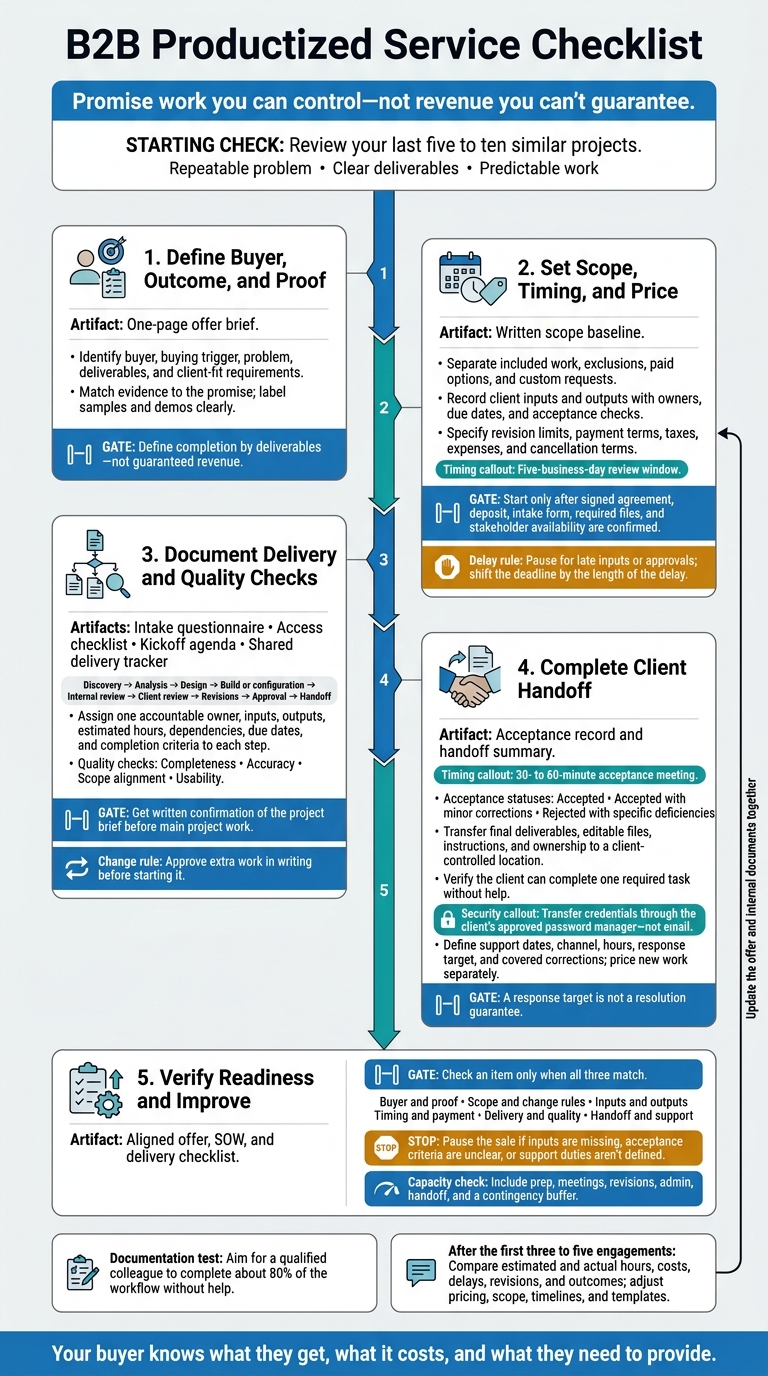
Before I package a consulting service, I check my last five to ten similar projects for a repeatable problem, clear deliverables, and predictable work. My rule: promise work I can control - not revenue I can’t guarantee.
I use this checklist to turn that work into an offer:
- Buyer and proof: Name who buys, why they need help now, what I’ll deliver, and what evidence supports the promise.
- Scope and price: Separate fixed work, paid options, and custom requests. Set client inputs, deadlines, review limits, payment terms, and acceptance checks.
- Delivery: Document each step, assign owners, and check the work before client review.
- Handoff: Transfer files and access, confirm ownership, and set a clear end date for support.
- Readiness: Check that the offer, agreement, and delivery plan match - and that I have time to do the work.
Then I test the process. I aim for a colleague to complete about 80% of the workflow without help, and I review actual hours and costs after three to five engagements.
The goal: your buyer knows what they get, what it costs, and what they need to provide.
Step 1: Define the Buyer, Problem, Outcome, and Proof
Choose a Buyer and Buying Trigger
Write a one-page offer brief that names the buyer’s role, company type, and job responsibility. Identify who feels the problem, who approves spending, and who influences the decision.
Describe how the problem affects day-to-day work. Then complete this prompt: The client is acting now because ___. Name a specific deadline or event - not a vague growth goal. Use that trigger to check whether your offer addresses a problem the client has reason to pay to solve.
Hypothetical example - not a client result: A Microsoft-focused alliance lead at a partner firm has 30 priority accounts, but 12 lack an assigned Microsoft seller owner. An upcoming quarterly business review makes a documented ownership and follow-up plan urgent.
Define the Outcome and Client Fit
Set a clear finish line for the package: within 15 business days, deliver a prioritized map of all 30 accounts, document each account’s seller ownership or unresolved status, set a follow-up cadence, and provide an executive-ready status report.
Base completion on those deliverables - not seller replies, meetings, pipeline value, or closed revenue.
Before accepting the client, record the requirements in the brief: usable account data, a named internal owner, permission to interview relevant staff, timely feedback, and authority to put the process into practice. A client without the needed data or executive sponsorship isn’t ready. Decline requests for guaranteed revenue.
Choose Proof That Supports Your Promise
Match your proof to what you promise to deliver. Use case-study metrics you have permission to share, client feedback, relevant credentials, or documented before-and-after workflows. Record the starting condition, actions taken, timeframe, measurement source, and permission to publish.
If you don’t have client evidence, show a clearly labeled sample account map or workflow demo. Samples can show how the process works, but they don’t prove results. Use this proof standard to set scope, outputs, and price in Step 2.
Step 2: Set Scope, Inputs, Outputs, Timeline, and Price
Turn your promise into a package buyers can purchase. Once you’ve defined the buyer, outcome, and proof, set clear limits on the work, timing, and price.
Define Scope and Exclusions
Create a written scope baseline that covers included work, exclusions, deliverable counts, meeting lengths, revision limits, tools, communication channels, response times, and client responsibilities.
Make the distinction clear: a revision changes an existing output. It doesn’t add a new deliverable. Get written approval for any change order before starting an add-on or separate engagement.
List Inputs, Outputs, and Acceptance Criteria
For every required input - whether it’s a file, access permission, stakeholder, decision, or approval - record the client owner, format or access method, due date, and consequence of delay.
For each output, specify its format, owner, due date, and acceptance check. Check that it’s complete, uses the agreed data, includes the required sections, and comes with editable files where promised. Assign one client approver to combine everyone’s feedback.
Set Delivery Dates and Review Windows
Start delivery only after confirming the signed agreement, deposit, intake form, required files, and stakeholder availability. Include milestone dates, a five-business-day review window, and the final delivery date in the agreement.
Pause delivery when inputs or approvals are late, and shift the deadline by the length of the delay. Update the scope to reflect approved changes before work resumes. Don’t shorten your production time to absorb client delays.[1][2]
Set the Price and Payment Terms
Base the package price on client value, delivery effort, client management time, overhead, expenses, payment risk, and target margin.
Example terms: A $3,000 package could require $1,500 at signing and $1,500 at draft delivery; pause work after a five-business-day payment grace period.
State whether the price includes applicable taxes and reimbursable expenses. Include cancellation terms and charges for completed work and reserved capacity. Put add-on prices in writing before the client approves them.[3]
Compare Service Package Structures
Choose the simplest package structure that fits the work. For unfamiliar requirements, use paid discovery or a separate scope.
| Package structure | Predictability | Margin control | Client flexibility | Delivery complexity |
|---|---|---|---|---|
| Fixed-scope package | High | High | Low | Low |
| Configurable package | Medium to high | Medium to high | Medium | Medium |
| Custom engagement | Low | Low to medium | High | High |
With the structure set, move to Step 3 to document delivery steps and quality checks.
Step 3: Document Delivery and Quality Checks
Make the package repeatable by documenting how you’ll deliver it. Once you’ve defined the package, lock in the delivery process before work begins.
Standardize Intake and Kickoff
Create three reusable assets: an intake questionnaire, access checklist, and kickoff agenda. Use them to record the client’s business goal, current state, target outcome, priority accounts or users, constraints, stakeholders, dependencies, and success measures.
Agree on milestones, communication channels, meeting cadence, who can make decisions, escalation rules, and who gives final approval. Put the answers in a project brief, name a backup approver, and log any unresolved assumptions. Wait for the client’s written confirmation of the brief before starting the main project work.
Map Delivery Steps and Assign Owners
Use one tracker to map discovery, analysis, design, build or configuration, internal review, client review, revisions, approval, and handoff. For each step, record one accountable owner, required inputs and templates, outputs, estimated hours, dependencies, due dates, and completion criteria.
Give each step a clear finish line. Discovery, for example, ends when the client confirms the priority problems. Reuse interview guides, requirements worksheets, deliverable templates, decision logs, and status updates. Keep owners, dates, and approvals in one shared workspace.
Set Quality Checks and Scope Change Rules
Before review, check completeness, accuracy, scope alignment, and usability. Verify source data, calculations, links, and assumptions, then save the completed checklist. Get approval on findings and proposed designs before building on them.
Put new requests in the change-order log, and wait for written approval before starting extra work. During weekly reviews, compare the remaining work with available capacity. Leave room for corrections instead of committing every available hour.
The handoff comes next: giving the client both the finished work and ownership.
Example: A Microsoft Co-Sell Delivery Workflow
Use this workflow to see how a productized Microsoft co-sell service stays repeatable.
Hypothetical workflow: Map target accounts, contacts, Microsoft owner, and relationship status. Confirm solution fit, prepare outreach materials, and select priority pursuits. Assign each pursuit a next action, owner, and follow-up date before marking it active. Execute the agreed tasks and review progress weekly. Account mapping is complete when ownership and next actions are recorded; outreach preparation is complete when the partner approves the messages and materials. Validate Partner Center readiness separately.
Step 4: Complete the Client Handoff
Transfer Files, Instructions, and Ownership
Once quality checks pass, move to formal acceptance and transfer. Hold a 30- to 60-minute acceptance meeting with the client approver. Record each deliverable’s file location, reviewer, and status: accepted, accepted with minor corrections, or rejected with specific deficiencies. Follow the contractual review deadline and document written acceptance or a specific list of exceptions.
Place final deliverables and editable source files in a client-controlled location. Include a handoff summary, implementation notes, a decisions and assumptions log, and maintenance guidance. Give every open item a client owner, backup owner, and due date. Clearly state which materials the client owns and which consultant templates or third-party assets remain subject to licensing terms.
Provide the agreed walkthrough and a guide. Ask the client owner to complete one required task without help, and confirm that files open and can be edited. Transfer credentials through the client’s approved password manager - not email. After verifying access, rotate shared credentials where needed. Remove unnecessary consultant accounts, guest permissions, and API tokens.
Set Support Terms and Close the Engagement
After transferring ownership, separate the support window from new work. Specify its start and end dates, support channel, escalation contact, business hours and time zone, and response target. Make clear that the response target is not a resolution guarantee.
Define which defect corrections and clarification requests support covers. Price new analysis, extra training, implementation, and continued maintenance separately. Include the agreed support window in the package price.
Before closing, confirm internal storage, assigned owners, required approvals, and the first maintenance review. Verify the written acceptance record, reconcile expenses, issue the final invoice, and complete any contractual IP transfer.
Send a closeout record listing remaining actions, support expiration, and access-removal dates. Archive, return, or delete materials according to the agreed retention terms, and record the disposition date.
Conclusion: Check Your Package Before Selling
Complete the Offer Readiness Checklist
Before selling, compare your offer, SOW, and delivery checklist. Check an item only when all three match:
- [ ] Specific buyer, buying trigger, pain point, and measurable outcome.
- [ ] Relevant proof that supports your promise.
- [ ] Defined scope, exclusions, and rules for scope changes.
- [ ] Required client inputs, with owners and due dates.
- [ ] Named outputs, acceptance criteria, and revision limits.
- [ ] Delivery dates, review windows, and rules for delays.
- [ ] Fixed price, payment schedule, taxes, expenses, and cancellation terms.
- [ ] Delivery steps, assigned owners, templates, and quality checks.
- [ ] Handoff responsibilities, ownership terms, and clearly limited support.
Pause the sale if inputs are missing, acceptance criteria are unclear, or support duties aren’t defined. Give each blocker an owner and a resolution date. The buyer should understand the deliverables, timing, price, and required inputs without needing a clarification call.
Check Capacity and Review Delivery Results
Next, test the package in practice. Ask a qualified colleague to run through the workflow using only your documentation. Record their questions and workarounds, fix gaps, and flag remaining decisions as escalation points. Aim for the tester to complete about 80% of the workflow without help.[4]
Calculate capacity in hours. Include prep, meetings, revisions, admin, and handoff, plus a contingency buffer. If you’re employed elsewhere, check employment, confidentiality, IP, and conflict restrictions. Get any required approval, and keep consulting separate from your employer’s time and systems.
After each engagement, compare estimated and actual hours, costs, delays, revisions, and outcomes. After the first three to five engagements, use those results to adjust pricing, scope, timelines, and templates. Update the offer and internal documents together so what you sell matches what you can deliver.
FAQs
How do I know which service to productize first?
Review your skills and pinpoint a high-value business problem you’re well suited to solve. Choose a service clients need and will pay for - one that plays to your strengths and fits your schedule.
Start with a premium, fixed-scope workshop or diagnostic that you can control and deliver from start to finish.
How can I validate demand before building my package?
Start with your target clients’ business problems and tie them to measurable outcomes, such as revenue growth. Then test interest: post content that shares your expertise and draws inbound leads.
Use discovery calls to understand each prospect’s challenges. From there, propose a simple scope of work that addresses those needs. If the prospect agrees that the scope and value make sense, you’ve validated a viable path forward.
When should I raise my package price?
Increase your package price when your service delivers clear business results and proven value, not just technical expertise. Charge based on the specific problems you solve for clients.
As your expertise grows, adjust your pricing to match high-end market rates for your specialized skills. Keep refining your services during client engagements so your fees reflect the value you deliver - and protect your time.